Union in the Seventh Valley
A Ghazal of Sorrow
By Abbas Na’lbandian
Translated from Persian by Neshat Sadatmansoori
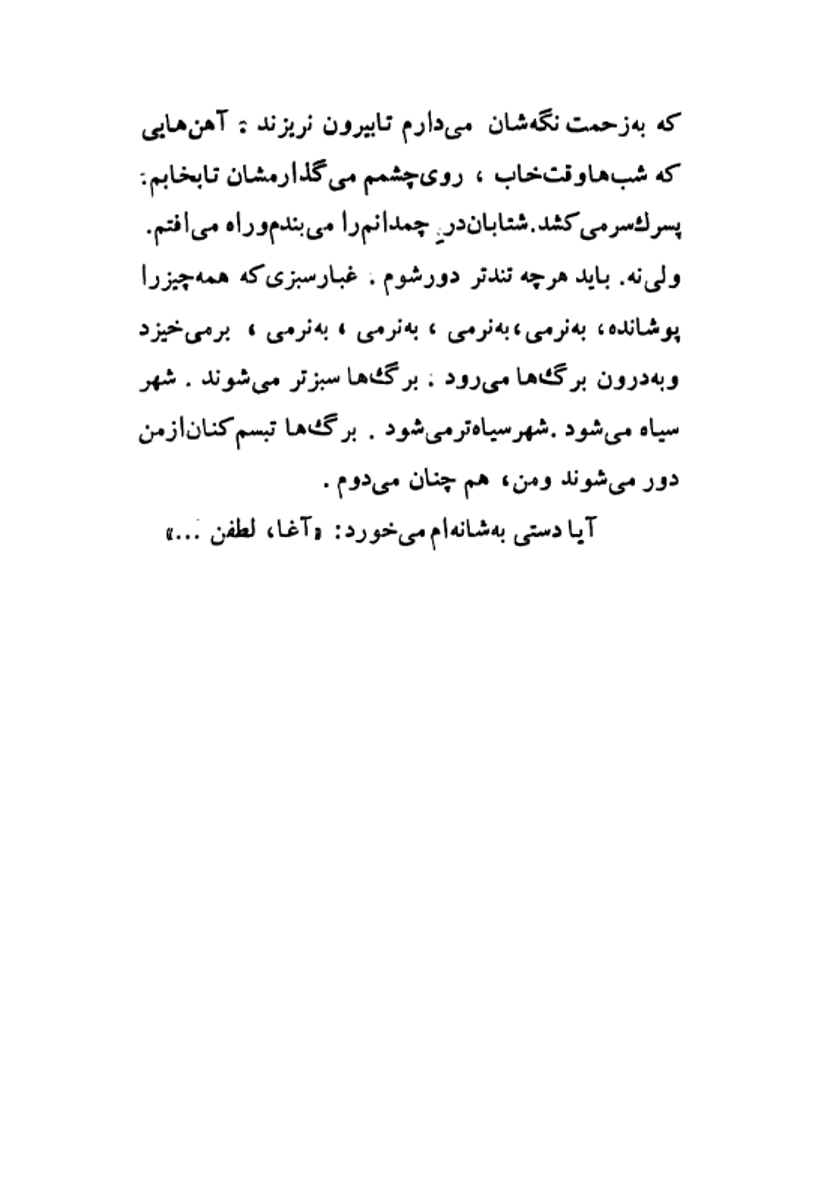
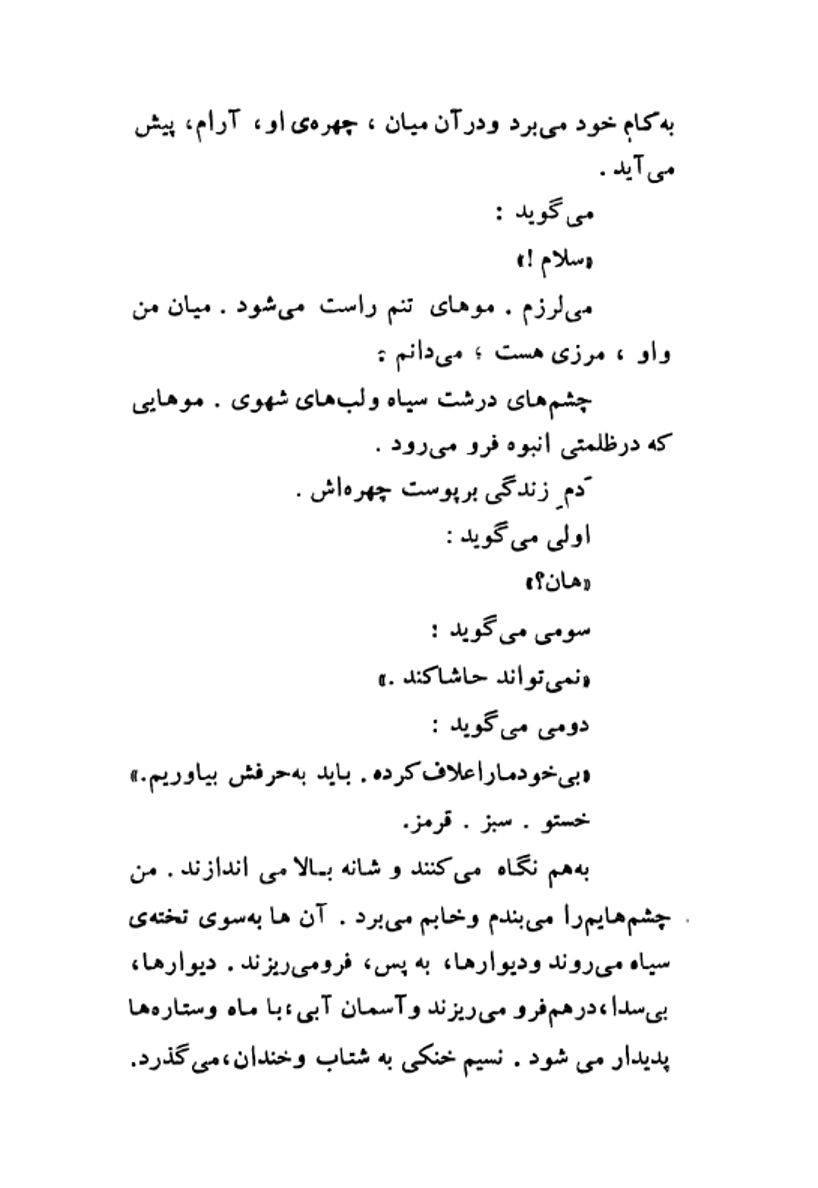
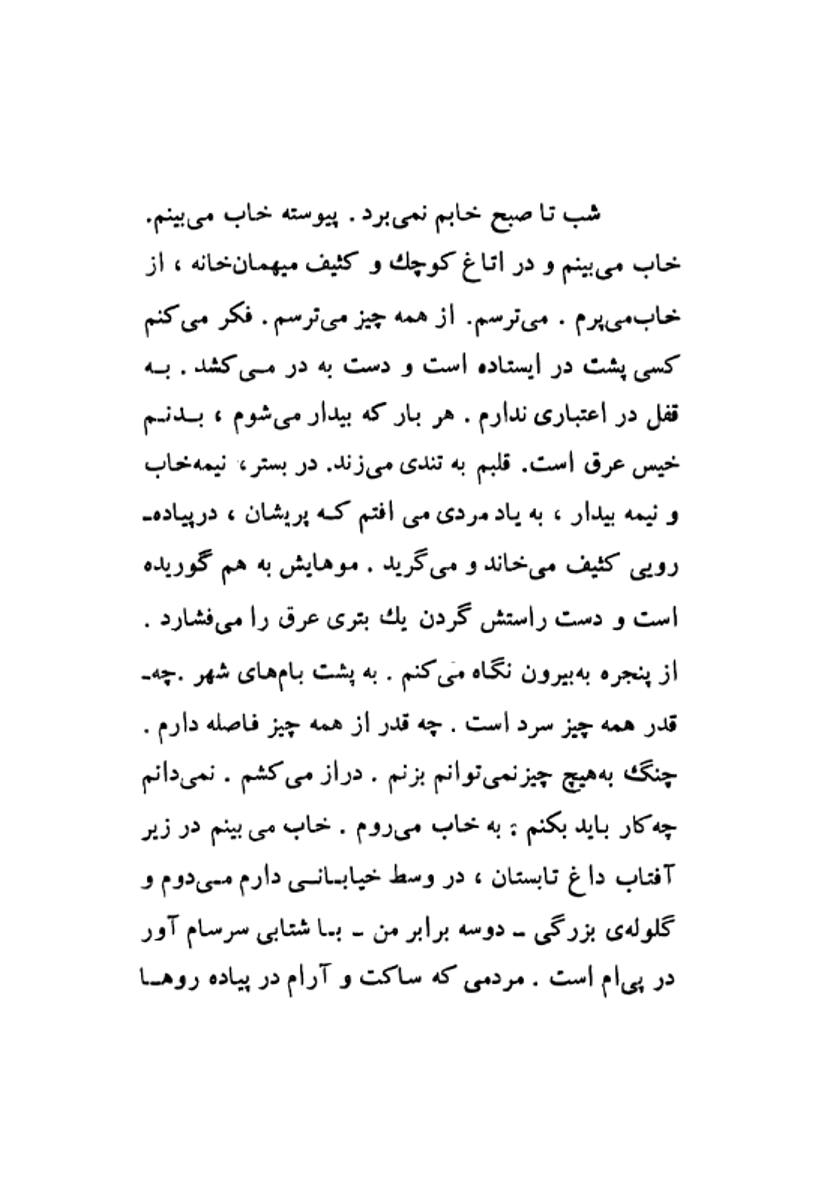
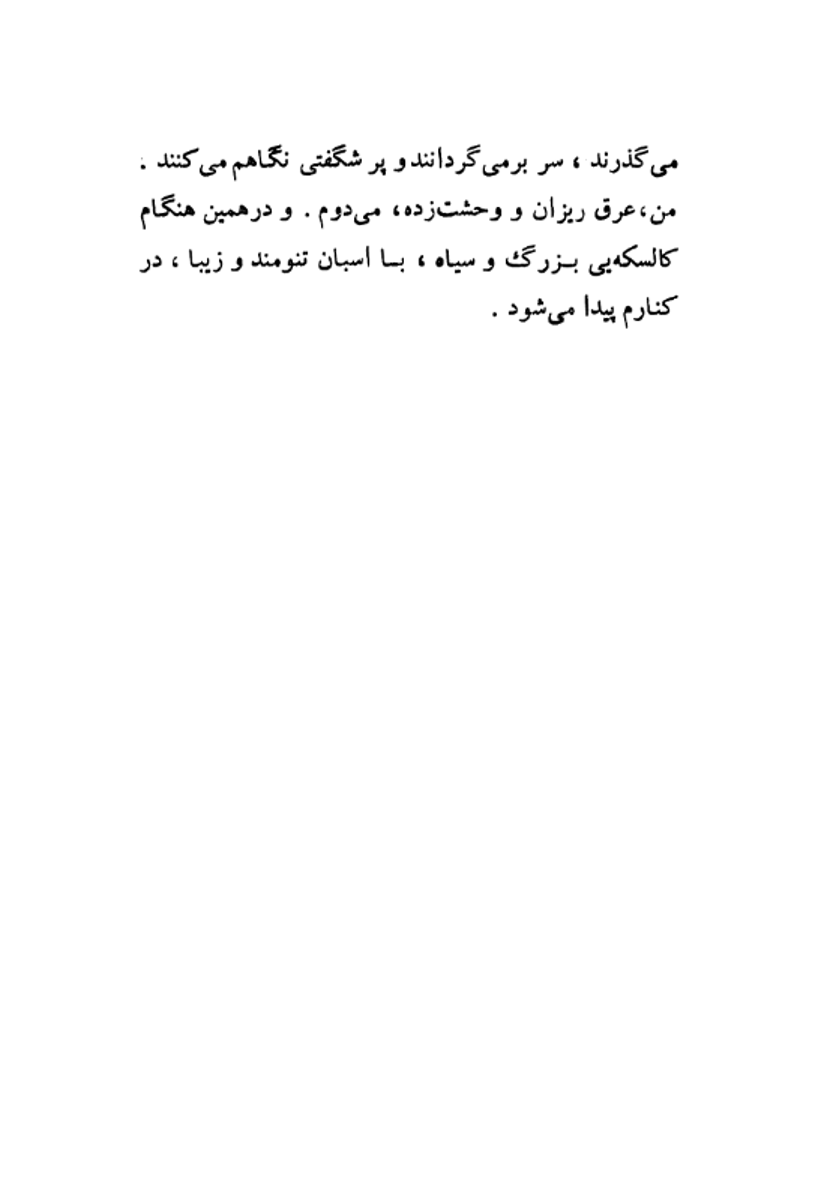
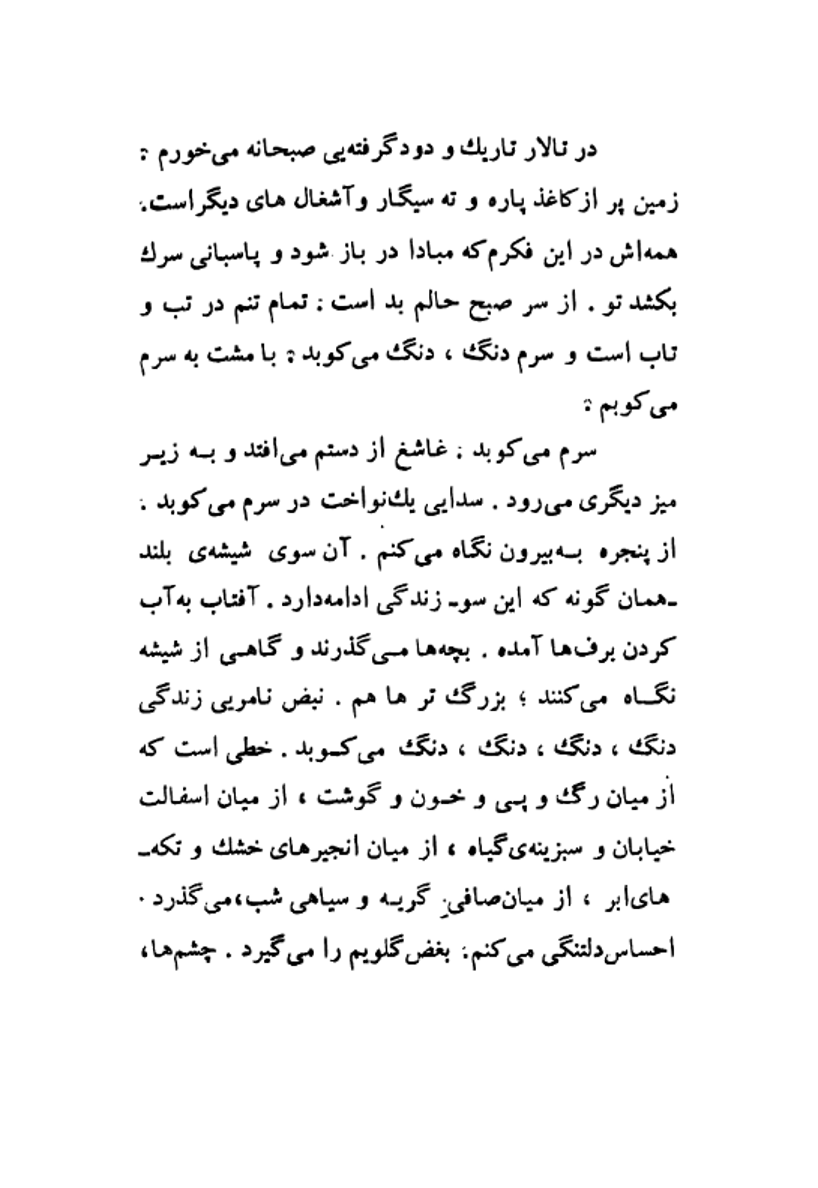
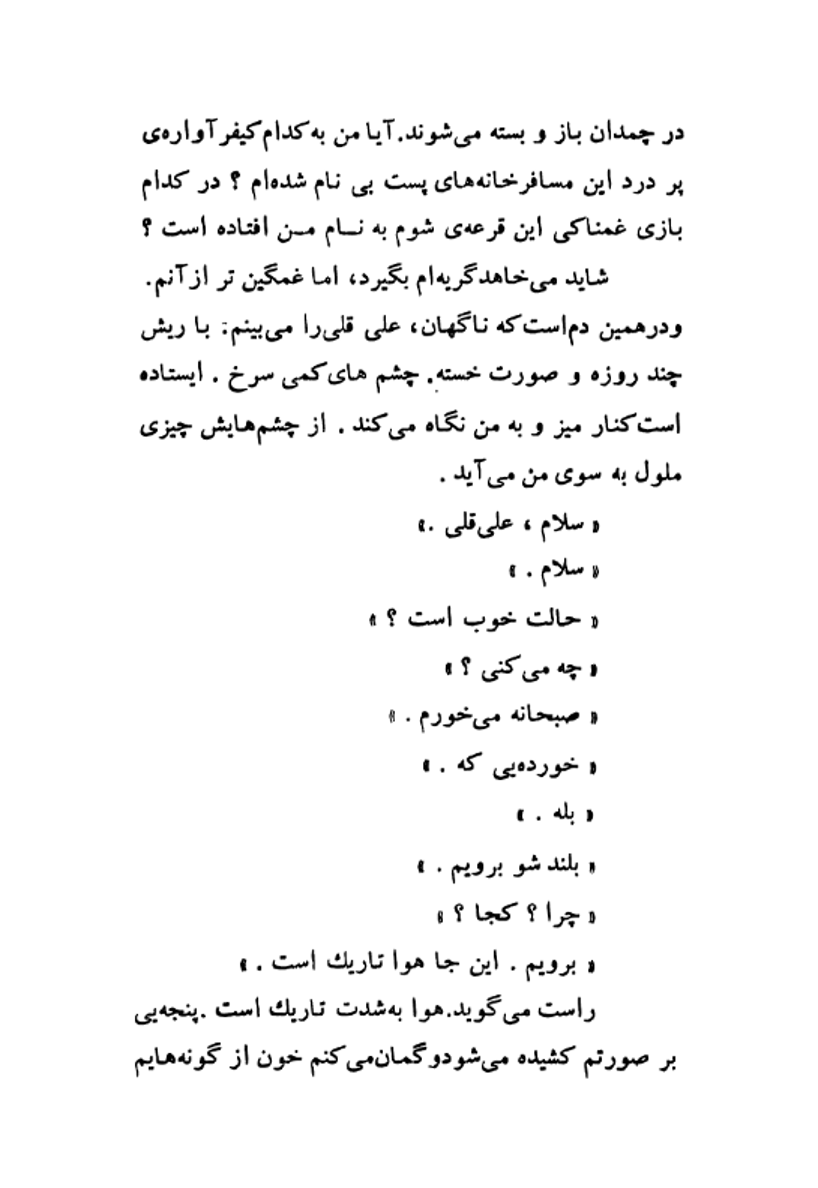
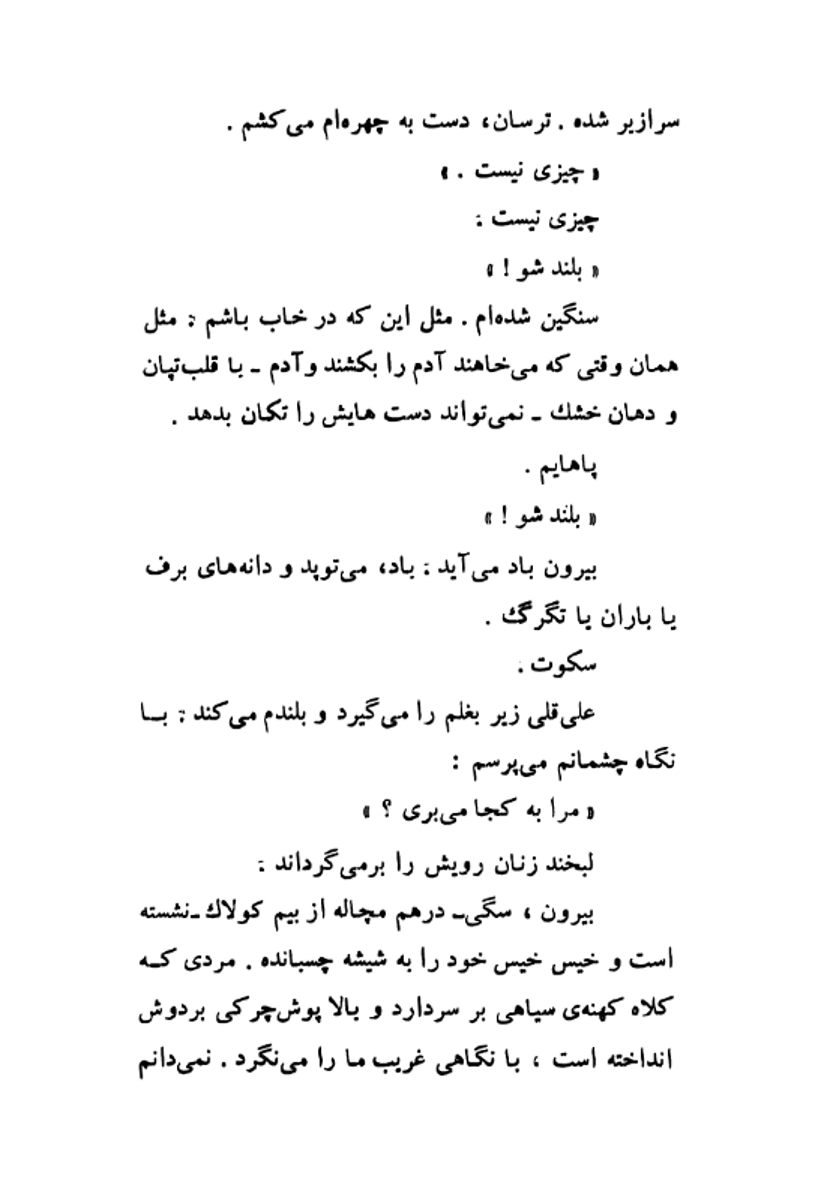
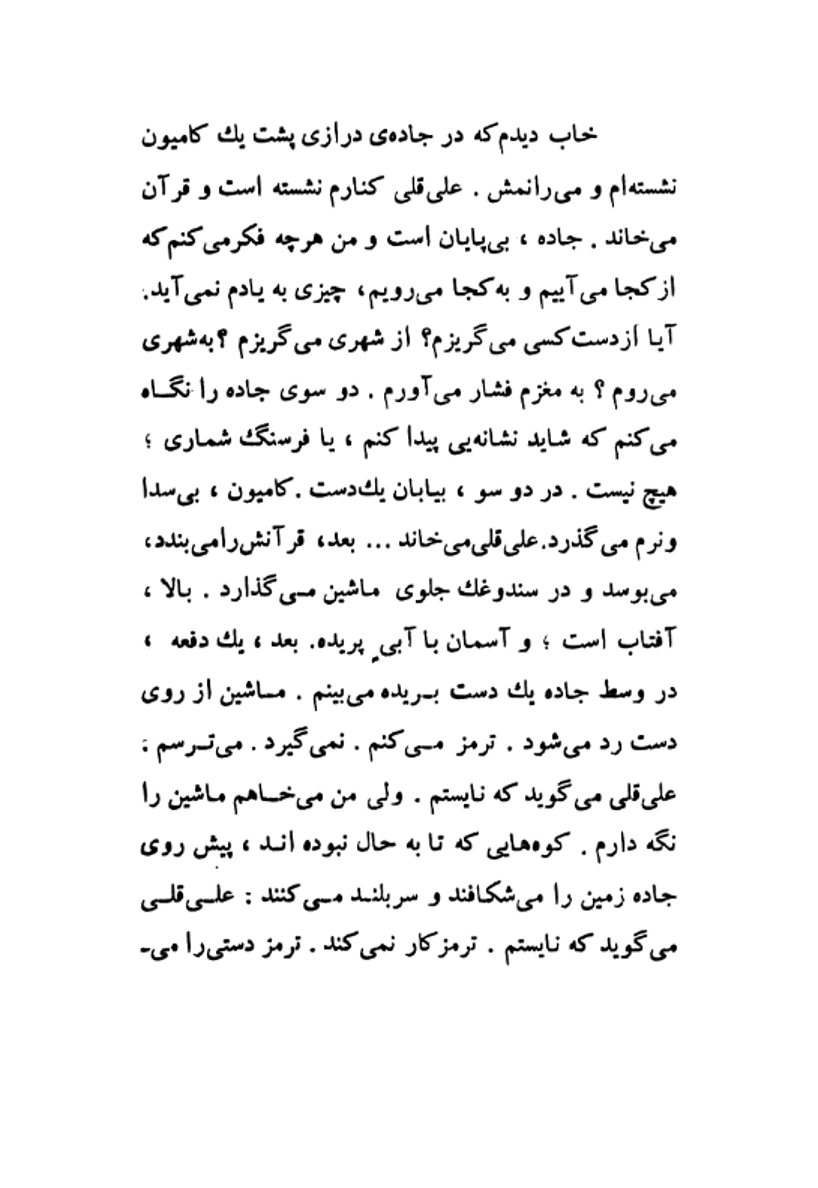
On the right: original Persian cover of Union in the Seventh Valley: A Ghazal of Sorrow by Abbas Nalbandian. Designed by Reza Maafi.
This piece is best viewed on desktop.
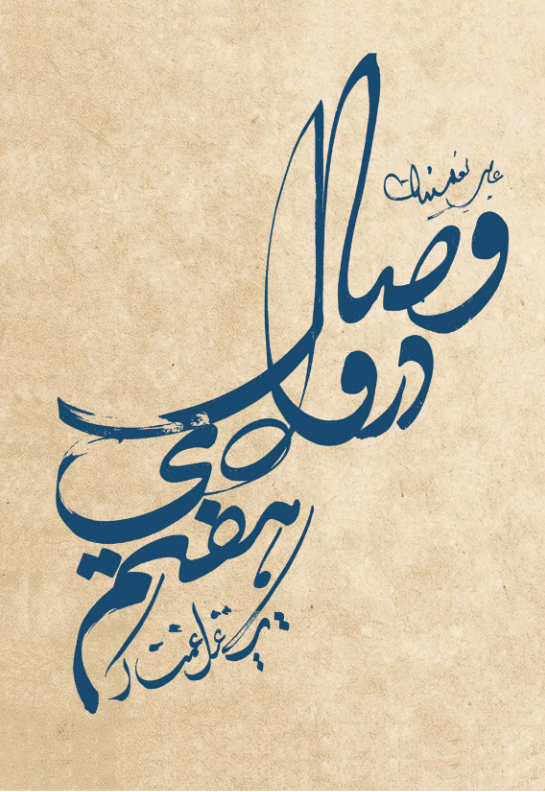
Union in the Seventh Valley: A Ghazal of Sorrow
“... And drunk, they spoke the shathiyat ;
and they broke the order of logic apart …”
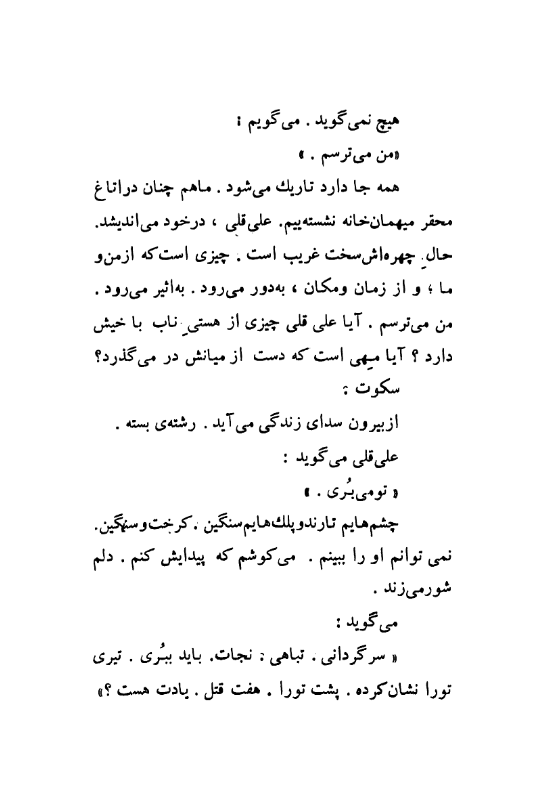
One
He says nothing. I say:
“I’m afraid.”
Everywhere is growing dark. We remain in the meager rhoom of the guesthouse. Aliqoli thinks to himself. The look on his face is strangely unfamiliar. Something in it drifts away from me, drifts away from us, drifts away from place and from time. Drifts into the ether. I am afraid. Does Aliqoli hold something of pure being within him? Is he a mist the hand passes through?
Silence.
From outside, the sownd of life comes. A closed thread.
Aliqoli says:
“You cut.”
My eyes are dim, and my eyelids heavy. Numb and heavy. I can’t see him. I try to find him. My heart is restless.
He says:
“Confusion. Ruin. Salvation. You must cut. An arrow has found you. Found your back. Seven murders. Do you remember?”
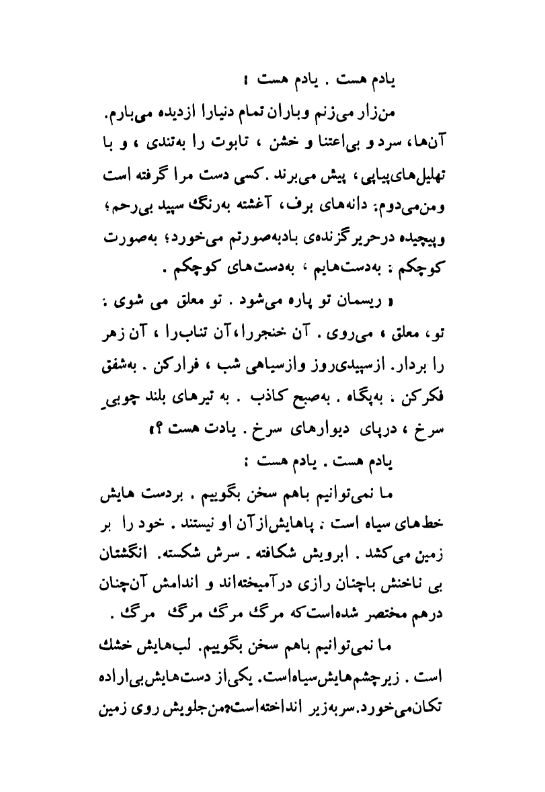
I remember. I do:
I wail, and from my eyes, I weep the rain of the whole world. They—cold, indifferent, and ruthless—push the coffin forward swiftly, with repeated chants of takbir. Someone is holding my hand, and I run. Snowflakes, soaked in cruel white, wrapped in the biting silk of the wind, strike my face, strike my small face, strike my hands, strike my small hands.
“Your rope snaps. You begin to fall. You—suspended—are leaving. Take that dagger, that rope, that poison. Flee from the brightness of day and the blackness of night. Think of dusk. Of dawn. Of the false morning. Of the tall red wooden stakes at the foot of the red walls. Do you remember?”
I remember. I do:
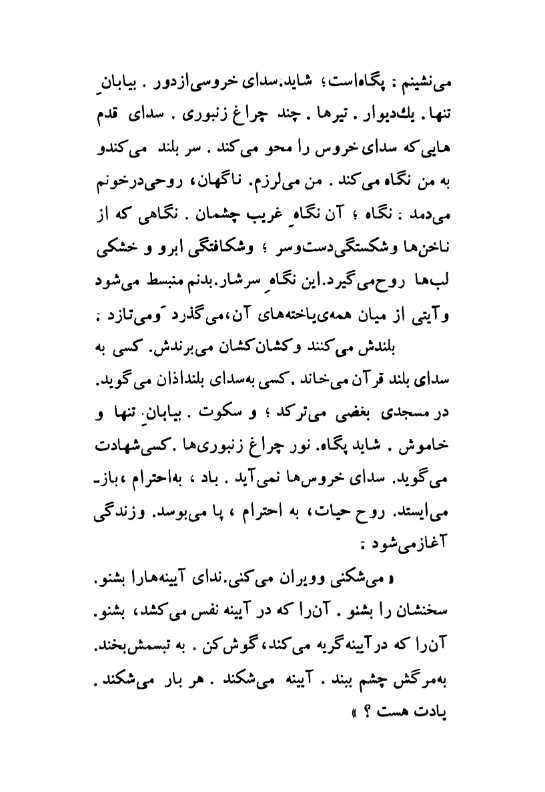
We cannot speak to each other. There are black lines on his hands. His legs are no longer his. He drags himself across the ground. His eyebrow is split. His head is broken. His nailless fingers are tangled with such a secret, and his body has collapsed into itself such that death death death death.
We cannot speak to each other. His lips are dry. The skin beneath his eyes is dark. One of his hands twitches involuntarily. He has bowed his head. I sit before him on the ground. It is dawn, perhaps. A rooster kauls, far away. A lonely desert. A single wall. The stakes. A few lanterns. The kry of footsteps drowning out the rooster’s kaul. He lifts his head and looks at me. I tremble. Suddenly, a spirit breathes into my blood. A gaze, the strange gaze from a set of eyes. The gaze finds its spirit from nails, from the brokenness of hand and head, from the splitting of eyebrows and dryness of lips. This overflowing gaze. My body expands, and a sign passes through every cell and rushes on.
They lift him, drag him away. Someone recytes the Quran aloud. Someone chants the azan aloud. In a mosque, a sob breaks open; and silence. A lonely, mute desert. Perhaps it is dawn. The light of the lanterns. Someone declares the shahada. The rooster’s kry does not come. The wind halts in reverence. The spirit of life kneels in reverence. And life begins:
“You break and destroy. Hear the kaul of the mirrors. Hear their speech. Hear the one who breathes within the mirror. Listen to the one who weeps within the mirror. Smile to their faint smile. Close your eyes to their death. The mirror shatters. And shatters again and again. Do you remember?”
I remember. I do:
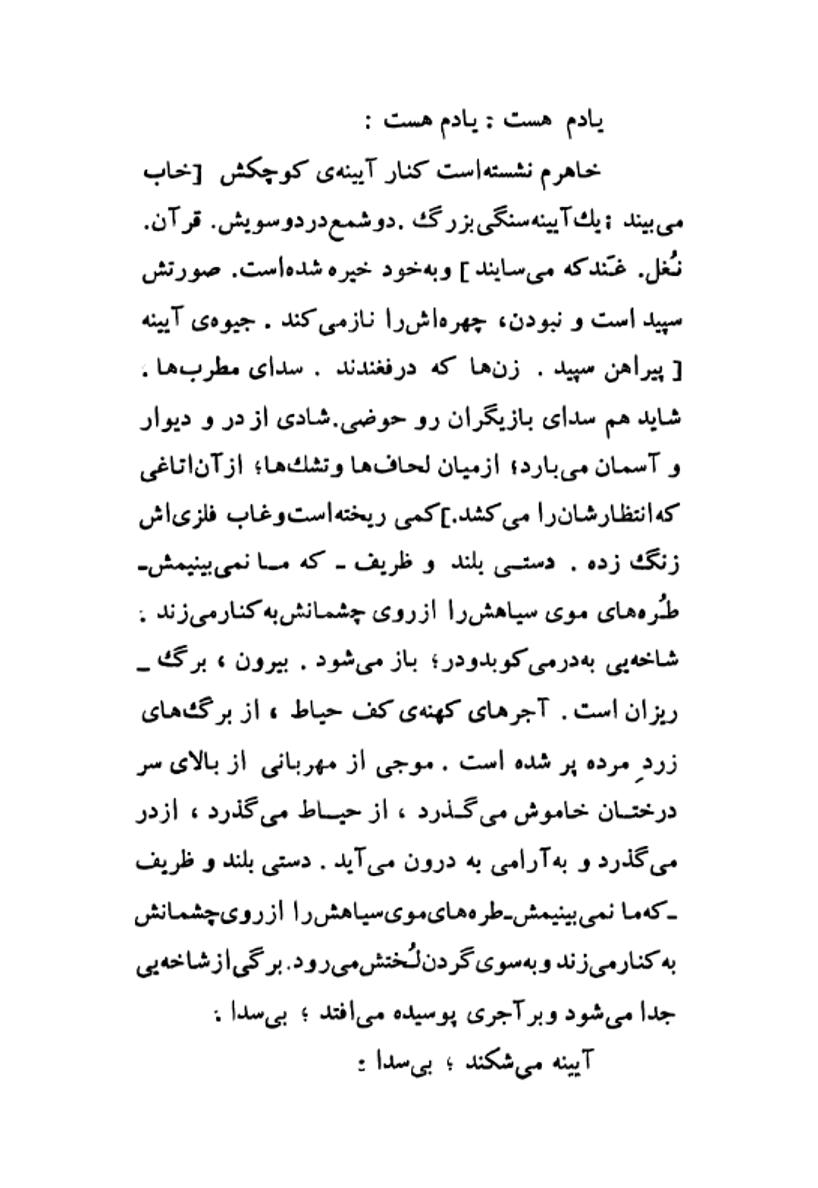
My syster sits beside her small mirror [she is dreeming: a wedding, a big stone mirror, two candles on either side. A Quran. Noghl. Two sugar cones are being ground into powder] and she stares at herself. Her face is pale, and absence caresses her face. The mirror’s mercury [a white dress. Women are bustling. The sownd of musicians. Or maybe the voyces of comic actors by the pool. Joy raining down from the sky, the walls, from between the quilts and mattresses, from that rhoom that awaits them] has partly pilled off. Its metal frayme is rusted. A long, slender hand—which we do not see—pushes strands of her black hair away from her eyes. A branch taps on the door and opens it. Outside, it’s leaf-fall. The worn bricks of the courtyard are covered in dead yellow leaves. A wave of tenderness passes over the silent trees, through the yard, through the doorway, and comes in slowly. A long, slender hand—which we do not see—pushes strands of her black hair from her eyes and moves toward her bare neck. A leaf separates from a branch and falls onto a weathered brick. Sowndless.
The mirror shatters, sowndless.
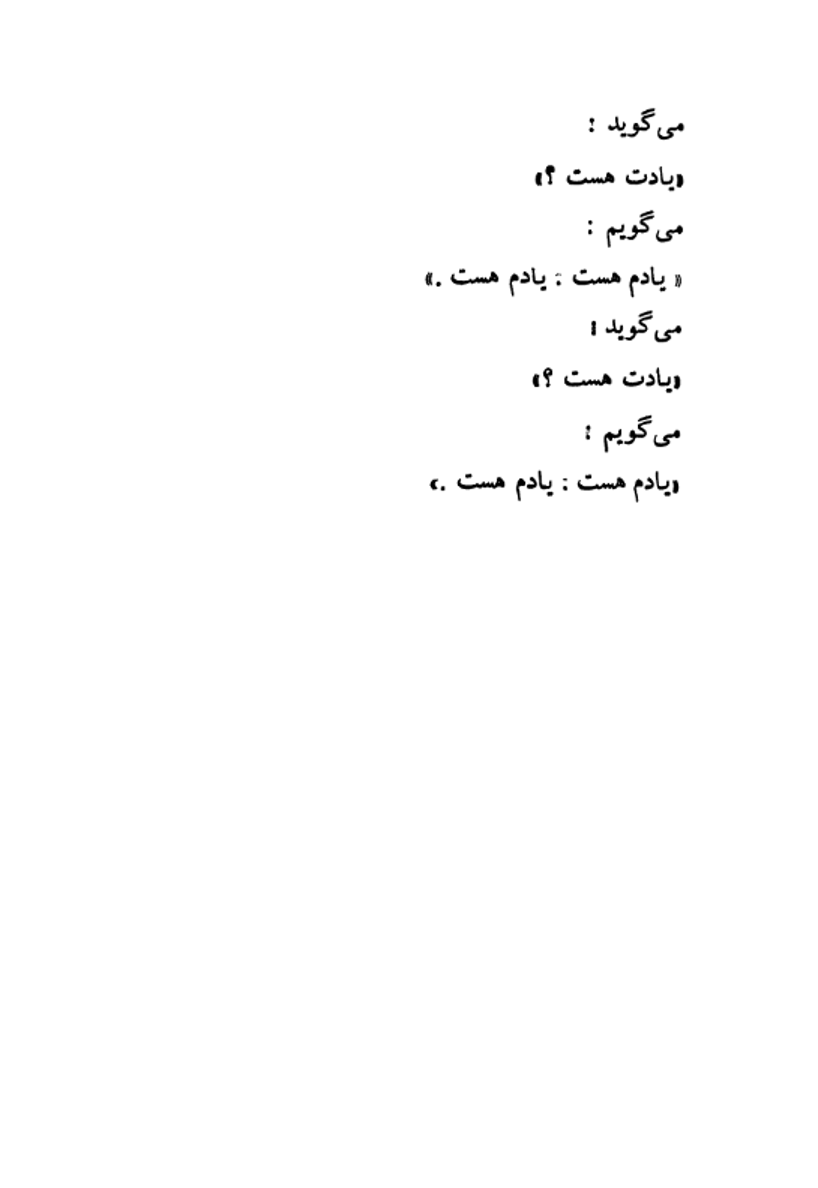
He says:
“Do you remember?”
I say:
“I do. I do.”
He says:
“Do you remember?”
I say:
“I do. I do”
Death
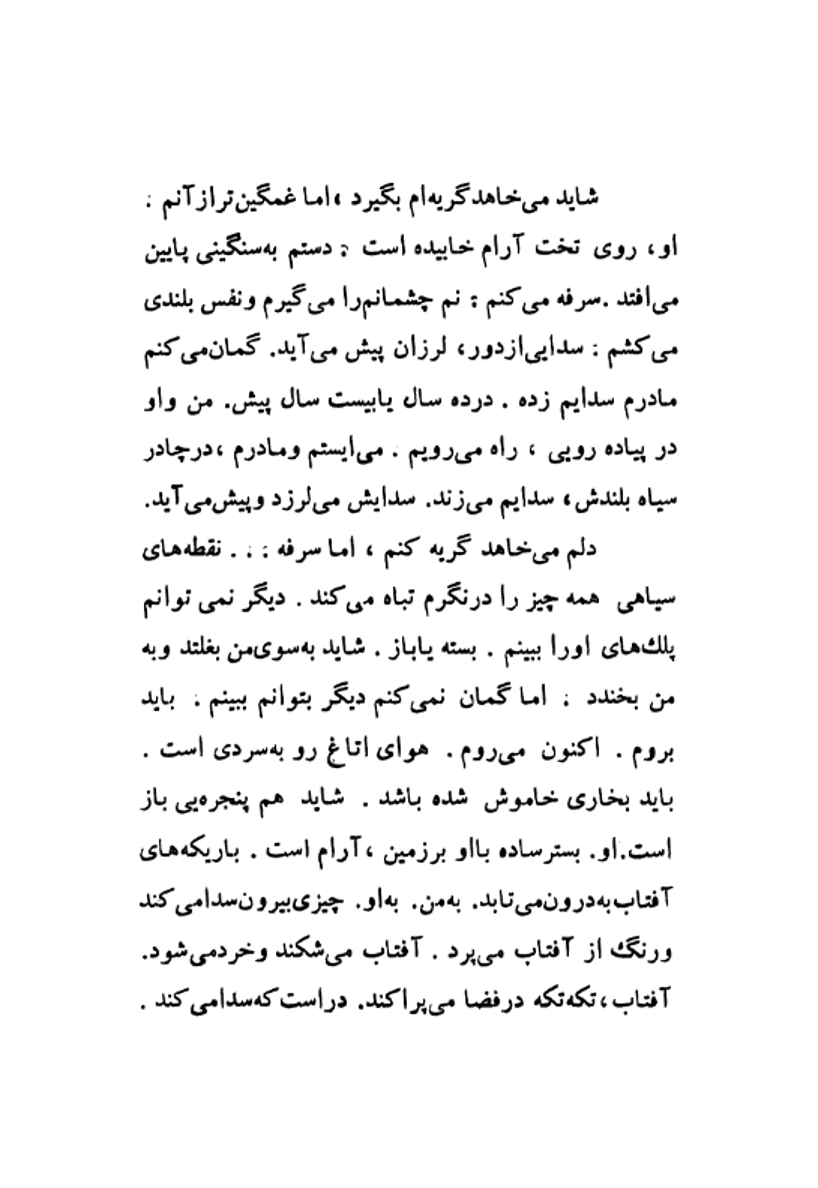
Maybe my tears whant to fall, but I am too sad for that.
He is asleepe on the bed in peace. My hand drops with weight. I cough. I dry my eyes and take a deep breath. A sownd gets closer from afar, trembling. I think my mother has kauled out to me. Ten years ago or twenty years ago: She and I are walking on a sidewalk. I stop, and my mother, in her long black veil, kauls out to me. Her voyce trembles and comes forward.
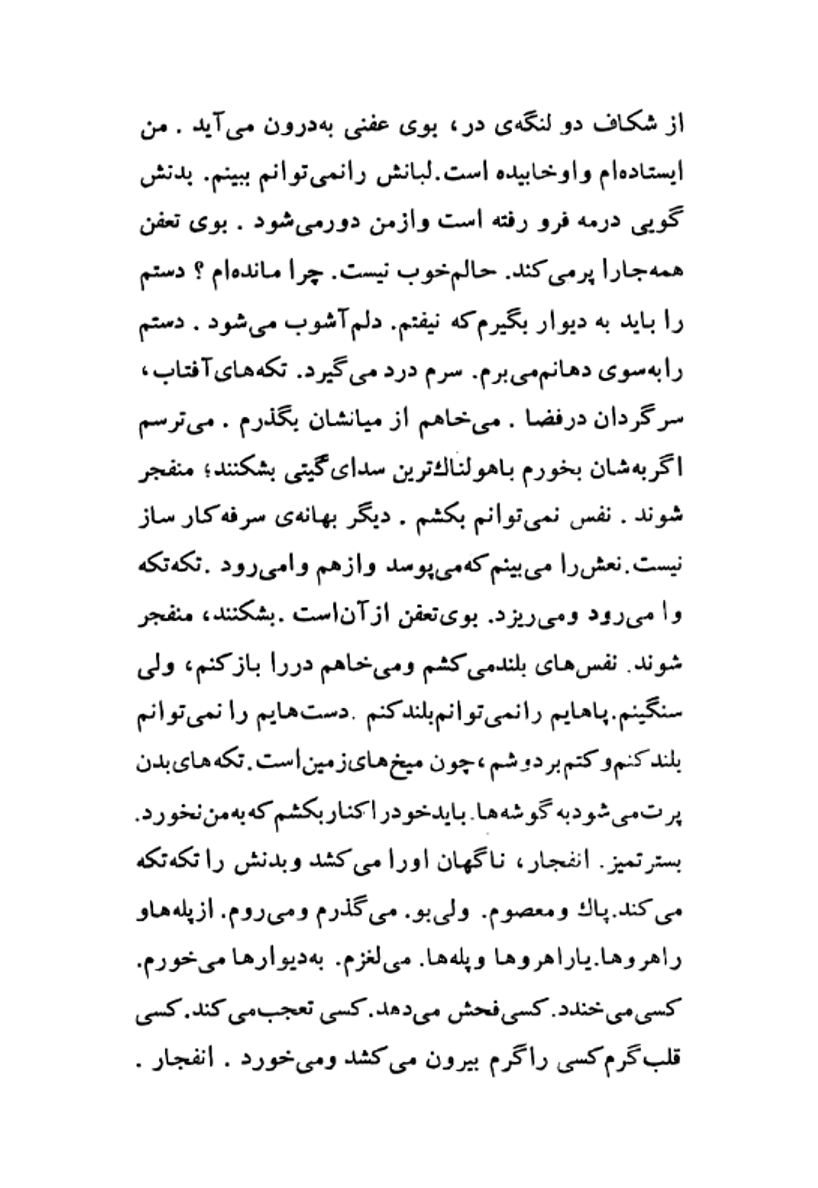
I whant to kry, but cough…black dots ruin everything in my sight. I can no longer see his eyelids. Closed or open. Perhaps he’ll roll around to face me and smile. But I don’t think I’ll be able to see anymore. I have to go. Now I am going. The rhoom is getting cold. The heater must have turned off. Perhaps a window is open as well. He. A simple bed with him in it is restful on the ground. Rays of the sun shine in. On me. On him. Something makes a sownd outside, and color leaves the face of the sun. The sun fractures and shatters. The sun scatters in the air, piece by piece. It’s the door that makes a cracking sownd. Through the gap between the double doors, the smell of feces drifts into the rhoom. I’m standing while he’s asleepe. I can’t see his lips. His body seems to have sunk into the fog and drifted away from me. A fetid smell fills the air. I don’t feel well. Why have I stayed? I have to cling to the wall, so I don’t fall. I feel nauseous. I bring my hand toward my mouth. My head aches. Pieces of the sun, wandering in the air. I whant to pass through them. I’m afraid that if I collide with them, they’ll break apart and explode with the most horrifying sownd in the universe. I can not breathe. Coughing is no longer working as an excuse. I see the corpse rotting and disintegrating. It falls apart and crumbles into pieces. The fetid smell is from it. Break apart, explode. I take deep breaths, and I whant to open the door, but I am heavy. I can not lift my feet. I can not lift my hands, and my coat sinks into my shoulders like stakes. Body parts are thrown to the corners. I must move aside to avoid being struck. A clean bed. An explosion, suddenly, pulls him in and shatters his body into pieces. Pure and innocent. But the smell. I walk and pass. Through staircases and corridors. Or corridors and staircases. I slip. I bump into the walls. Someone laughs. Someone curses. Someone is shocked. Someone pulls out someone’s warm heart with warmth and devours it. Explosion. Ab, Ibn, Ruh al-Qudus. Amen. Red, crimson, blood. On the sidewalk, I see everything green. I button up my coat. Perhaps it’s for the trees. Maybe it’s for the trees that I see everything green. I love trees. Green. Sunflower and grapevine and fruit leather. Next to the sidewalk of a small, unpaved square. Kids are buying. I stand and gaze green. I feel better. I think if I turn back and glance over my shoulder, the house and he explode together. Then everyone would understand. I think I need to button up my coat. Like Sodom and Gomorrah. Perhaps I had gone with him. Perhaps I had stayed back in Gomorrah. “How much are these, baba?”As we were walking down the street, my father, mother, and I. I felt too shy to ask, “baba, I whant some.” I would say it like that, and he would buy them. The workers are sifting soil in the middle of the small square. Someone is reading a letter to a few people. Suddenly, I feel I’ve forgotten my suitcase. I stop and feel scared. I crouch down on the sidewalk and open my suitcase. An old woman walks by me, glancing suspiciously, and a child stops to watch me. Sunflower and grapevine and fruit leather and a tear bottle. A pair of lustful lips. Too many words I struggle to keep from slipping out. The irons I lay over my eyes at night to sleepe. The little boy wanders. With haste, I fasten the suitcase and set off. But no. I must get away as fast as I can. The green dust, covering everything, softly, softly, softly, softly rises and penetrates the leaves. The leaves become more green. The city becomes dark. The city becomes darker. The leaves drift away, smiling—and I am still running.
Does a hand touch my shoulder: “Ser, please…”
Three
A somewhat worn table. Someone behind it. Two others in the rhoom. My eyelids are heavy, closing constantly. I can’t see the door.
Someone says:
“Did you kill your brother?”
I laugh. Blood drips from my fingertips. And drops on my lips, on my eyes. Fresh blood.
The men whisper among themselves. A putrid smell turns my stomach. Further off in the rhoom, someone writes something on a blackboard, then points to a set of stairs in the corner leading upward.
My eyelids are heavy. I whant to rise. The men move toward me.
The second says:
“Then what were you doing there?”
The third says:
“You can’t deny it. They saw you leaving the house in a green coat.”
The first says:
“What did you do with the coat?”
I look at my coat. A milky, ether-like haze swallows all three men, and from amidst this, his face, calm, emerges.
He says:
“Hello.”
I tremble. My skin bristles. There is a border between us; I know.
Wide black eyes and lustful lips. Hair that sinks into a heavy darkness. The breath of life on the skin of his face.
The first says:
“Well?”
The third says:
“He can’t deny it.”
The second says:
“He’s wasting our time. We’ll make him talk.”
Confessor. Green. Red.
They look at one another and shrug. I close my eyes and fall asleepe. They walk toward the blackboard, and the walls crumble backward. The walls crumble on one another without a sownd, and the blue sky, with its moon and stars, appears. A cool breeze passes, quick and laughing.
Four
I can’t sleepe through the night. I keep dreeming. I dreem, and I wake up in the small, filthy guest rhoom. I’m afraid. I’m afraid of everything. I think someone is standing behind the door, running their hand over it. I don’t trust the lock. Each time I wake, my body is soaked in sweat. My heart races. In bed, half-asleepe, half-awake, I remember a man who, distressed, syngs and weeps on a dirty sidewalk. His hair is matted, and his right hand clenched the neck of a bottel of liquor. I look out the window. At the rooftops of the city. Everything feels so cold. I feel so far from everything. I can not clutch at anything. I lie down. I don’t know what to do. I fall asleepe. I dreem I’m running under the hot summer sun, in the middle of a wide street, and a massive rolling ball—two or three times my size—is chasing me at dizzying speed. People walking quietly along the sidewalks turn their heads and watch me with surprise. I run, sweating, terrified. And just then, a large black carriage pulled by strong, beautiful horses appears beside me.
Five
I’m eating breakfast in a dark, smoke-filled hall. The floor is littered with scraps of paper, cigarette butts, and other trash. All I can think is what if the door opens, and a guard peeks in. I’ve been sick since the morning. My whole body is restless, feverish, and my head pounds, dong, dong. I pound my head with my fist.
My head pounds. The spoone slips from my hand and falls beneath another table. A constant sownd pounds in my skull. I look out the window. On the other side of the tall glass, just like on this side, life continues. The sun has come to melt the snow. Children pass by, and sometimes they glance in. So do the grown-ups. The invisible pulse of life pounds dong, dong, dong, dong. It is a line that runs through veins and sinew, through blood and flesh, through the asphalt of streets and the green hush of plants, through dried figs and fragments of clouds, through the brightness of tears and the blackness of nights. I feel longing. A lump rises in my throat. Eyes open and shut inside the suitcase. By what punishment have I become painfully displaced in these cheap, nameless guesthouses? In what sorrowful game was this dark fate drawn in my name?
Maybe my tears whant to fall, but I am too sad for that. And it is right then that, suddenly, I see Aliqoli. With a few-days’-stubble and tired features. Slightly red eyes. He’s standing by the table, looking at me. Something weary flows from his eyes toward me.
“Hello, Aliqoli.”
“Hello.”
“Are you well?”
“What are you doing?”
“I am having breakfast.’’
“But you have already.”
“Yes.”
“Get up. Let’s go.”
“Why? Where?”
“Let’s just go. It’s too dark here.”
He’s right. The air is thick with darkness. A claw scrapes across my face, and I think blood is running from my cheeks. Frightened, I run my hand over my face.
“It’s nothing.”
It’s nothing.
“Get up!”
I’ve grown heavy. As if in a dreem: Like that moment when they’re trying to kill you and you—with a pounding heart and a dry mouth—can’t move your hands.
My legs.
“Get up!”
Outside, the wind blows. The wind howls, and flakes of snow or rain or hail.
Silence.
Aliqoli gets under my arm and lifts me. With my eyes, I ask:
“Where are you taking me?”
Smiling, he turns his face away.
Outside, a dog sits, curled in fear of the blizzard, all wet, pressing itself against the window. A man in a tattered black hat and a dirty overcoat stares at us with a strange look. I don’t know who Aliqoli is looking at.
“Where are we going, Aliqoli?”
“Let’s go.”
We go.
As we step outside, the air improves. The dog shakes itself off, and the man in the hat is gone. The air is good.
The air is good. The dog.
I take a deep breath and smile. Now I can see Aliqoli’s face more clearly. His face is pale, and he doesn’t breathe well. He’s deep in thought. We start walking. A truck, blaring its hoarn, barrels past us at a dizzying speed, drenching us—wet-red-wet. Aliqoli looks at me, and—does he know?—He smiles.
Six
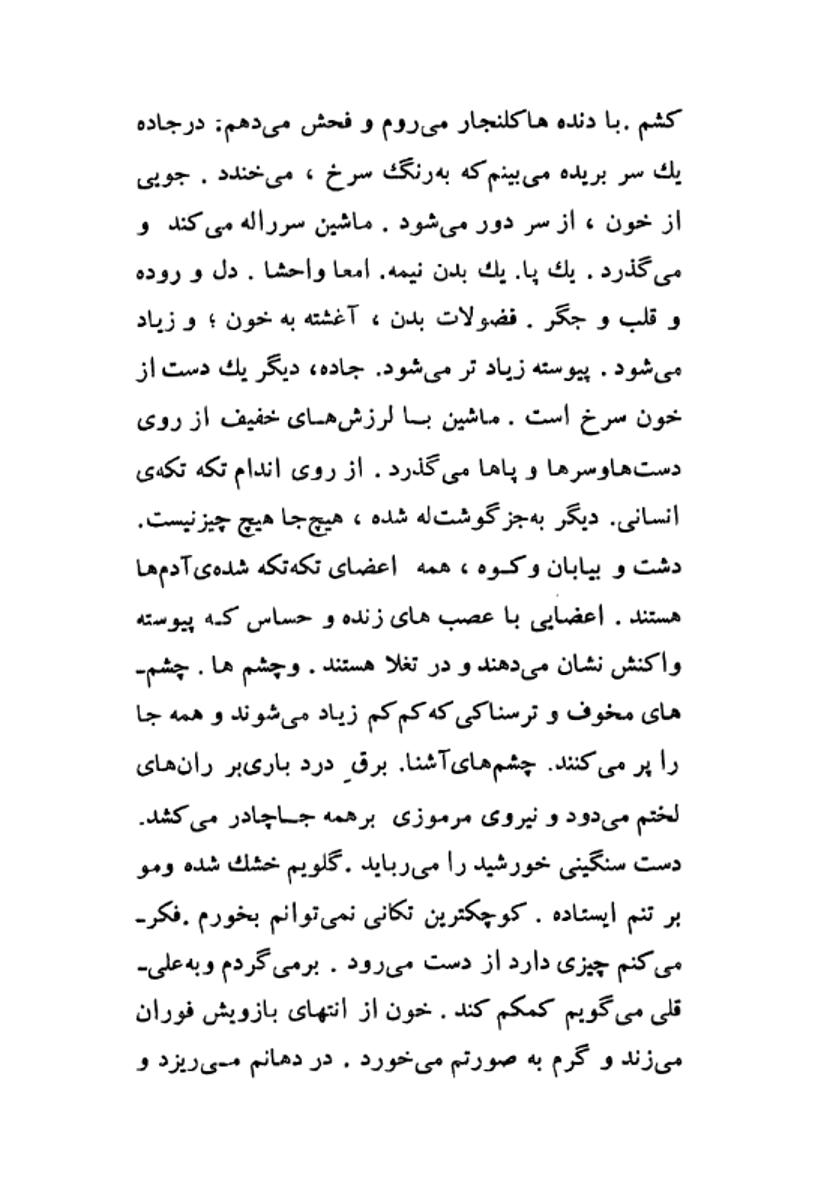
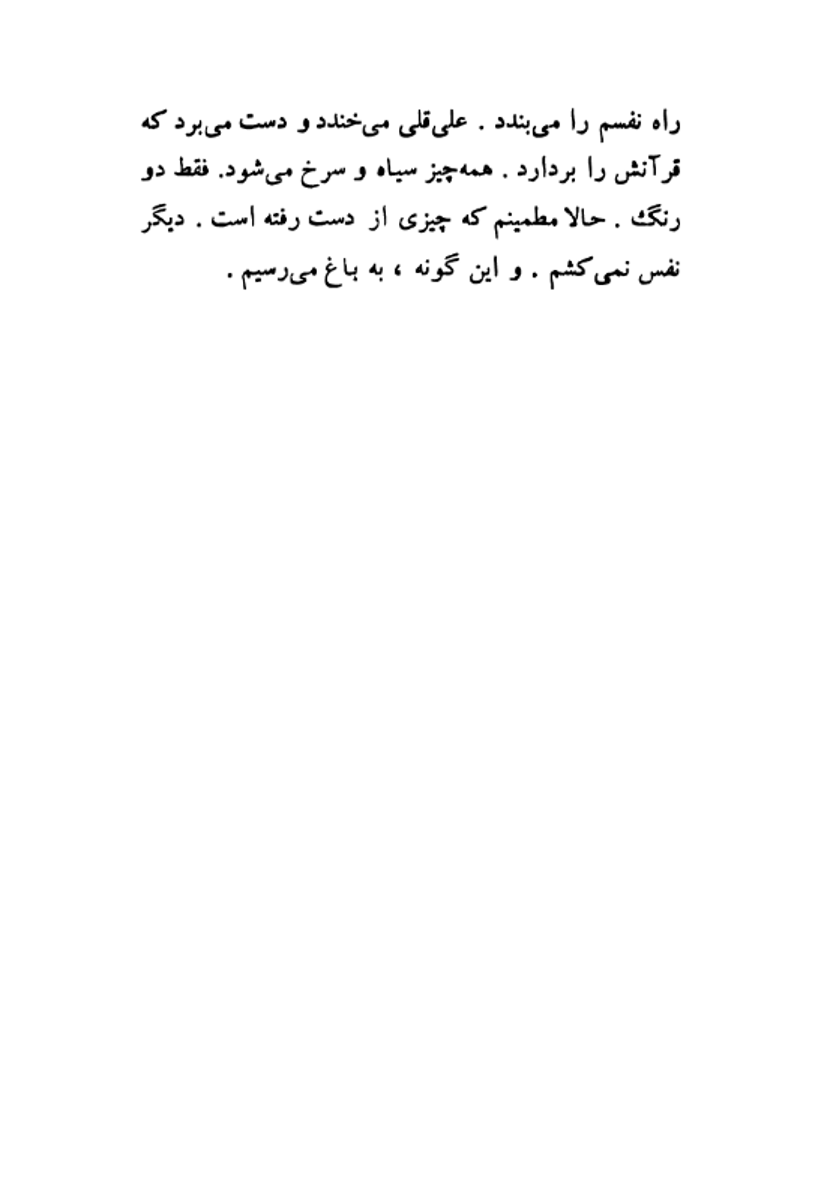
I dreemed that I was driving a long road, sitting behind the wheel of a truck. Aliqoli sits beside me, recyting the Quran. The road stretches endlessly, and no matter how much I try to remember where we are coming from or where we are going, nothing comes to my mind. Am I escaping from someone? Running away from a city? Heading toward one? I strain my brain. I look to both sides of the road, hoping for a sign or a distance marker, but there is nothing. On both sides, an unchanging desert. The truck moves smoothly and silently. Aliqoli continues to recyte... then he closes his Quran, kisses it, and places it in the glovebohx. Above is the sun; and the sky in a faded blue. Then, suddenly, I see a severed hand in the middle of the road. The truck rolls over the hand. I brake. It doesn’t work. I am scared. Aliqoli tells me not to stop. But I whant to bring the truck to a halt. Mountains that hadn’t been there before rise immediately along the road ahead, piercing the ground. Aliqoli tells me not to stop. The brakes don’t work. I pull the handbrake. I struggle with the gears, and swear. On the road, I see a severed head, red and laughing. A trickle of blood streams away from the head. The truck crushes the head and moves forward. Then, a foot. A body in half. Entrails. Intestines and heart and liver. Body waste, mixed with blood. Increases and continues to increase. The road is now all covered in blood. The truck moves with slight vibrations over hands and heads and feet. Over the dismembered human parts. There is nothing left anywhere but crushed flesh. The plain, the desert, and the mountain are dismembered human parts. Parts with living, sensitive nerves that constantly react and twich. And the eyes. Terrifying, ominous eyes that gradually multiply and fill every space. Familiar eyes. A sharp, painful sensation runs through my bare thighs, and a mysterious force shrouds everything. A heavy hand snatches away the sun. My throat is parched, and the hair on my body stands on end. I can’t move at all. I feel like something is being lost. I turn and ask Aliqoli to help me. Blood gushes from the end of his arm, slapping warm against my face. It pours into my mouth, blocking my breath. Aliqoli laughs and reaches out to pick up his Quran. Everything turns black and red. Only two colors. I’m now certain that something has been lost. I am no longer breathing. This is how we reach the garden.
This translation was supported by an Emerging Translator Mentorship from the American Literary Translators Association. Read more at www.literarytranslators.org.



-
Abbas Nalbandian (1947–1987) was an Iranian playwright and theatre director, regarded as a pioneer of absurd and experimental theatre in Iran. Known for his radical use of language and unconventional structures, his selected works include A Deep, Big and New Research about Fossils of the 25th Genealogy Period, or the 20th, or Any Other Period, There Is No Difference (1966), If Faust Was a Real Friend (1967), Stories from the Rains of Love and Death (1977). He died by suicide on 28 May 1987.
-
Neshat Sadatmansoori is an Iranian writer, translator, and interdisciplinary artist currently pursuing a PhD in Creative Writing at the University of Denver. She holds an MFA in Creative Writing from the Jack Kerouac School of Disembodied Poetics, where she was named the Anne Waldman Fellow. She was recently published in Bombay Gin and will appear in an upcoming issue of Sinister Wisdom. She is also the recipient of the 2025 ALTA Emerging Translator Mentorship.