RESONANCE
FOUR POEMS BY LYUDMYLA DIADCHENKO
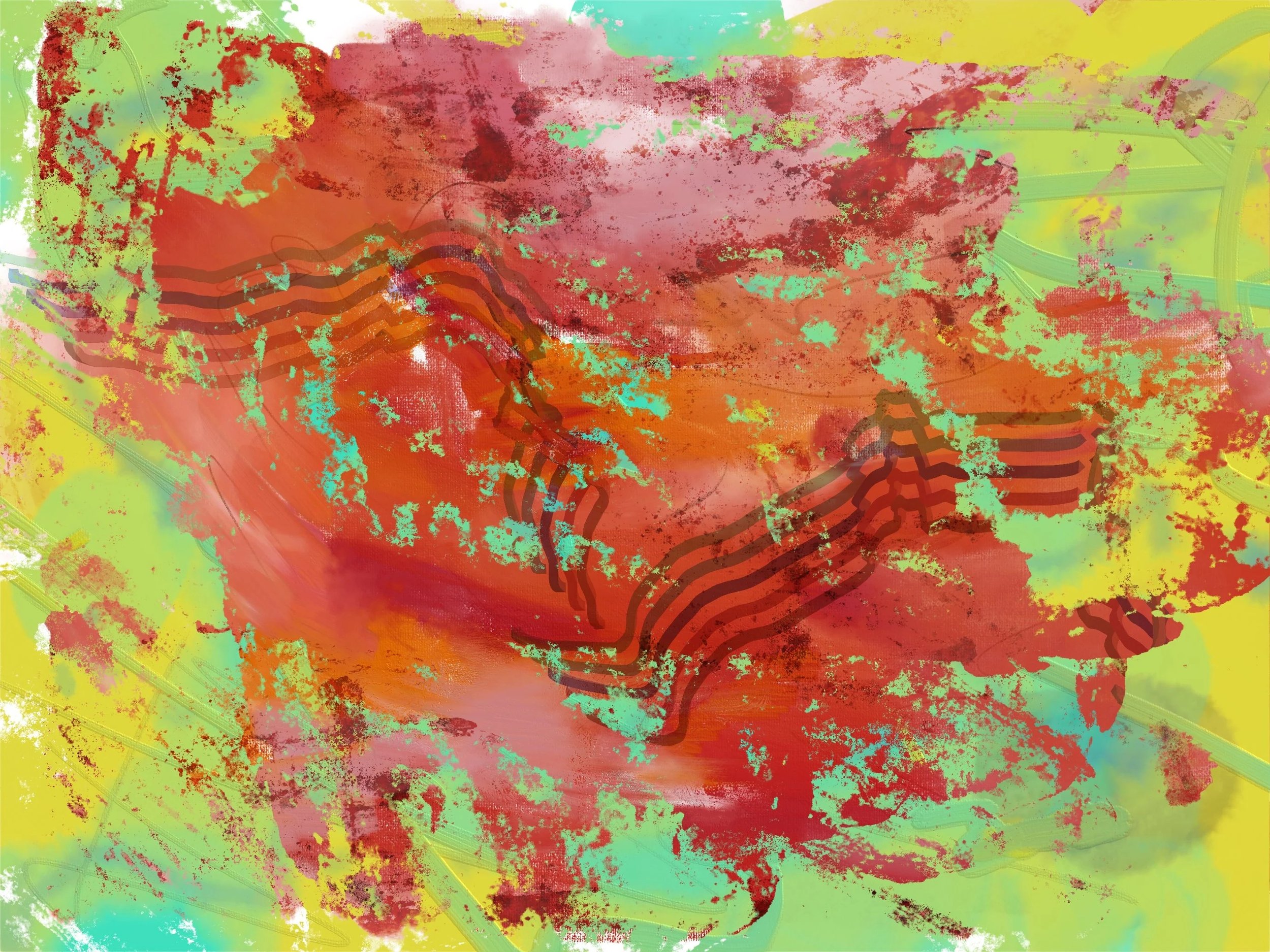
Art by Kelley-Marie Van Dilla
Translator’s Note
Prior to my becoming aware of Lyudmyla Diadchenko’s poetry in 2021, her English translations were made by fellow Ukrainians whose sense of the English tongue was dictated by syntactical sensibilities germane to Ukrainian but awkward in English. Despite their frequently puzzling constructions, what shone through most vividly were Diadchenko’s keen intelligence and poetic precision. I thought I could help and offered my services. I am likely of Ukrainian extraction on my mother’s side, and took a keen interest in Ukrainian literature as early as the 1990s, especially due to the six-volume Women’s Voices in Ukrainian Literature (1998-2000) published by Language Lanterns Publication and the shorter anthology, From Three Worlds: New Writing from Ukraine (1996)from Glas Publishers and Zephyr Press. My readings exposed me most notably to the plays of Lesya Ukraïnka, the short stories of Olha Kobylianska, and the poetry of both Oleh Lysheha and Vasyl Stus. I am admittedly not fluent in Ukrainian; however, one advantage of the Internet age is the ready availability of Ukrainian-English dictionaries online. My process begins with a painstaking, word-by-word translation using three such dictionaries, followed by a restructuring of the text to make it sensible in English. Having devoted my life to writing poetry, I trusted my poetic instincts to compensate for not knowing Ukrainian. Once I’ve created a coherent translation, I send the drafts to Dr. Diadchenko herself, who corrects any mistakes (the online dictionaries, it turns out, don’t always agree!) and fills me in on nuances I may have missed—cultural allusions to Ukrainian folktales, for instance. Her advisory role in my translations is therefore critical, and we do not submit the poems for publication until we’ve both agreed they are ready.
I have not considered Diadchenko a “war-time poet” because I began translating her work in March 2021, eleven months before the full-scale Russian assault began in February of 2022 (since 2014, Russian aggression had been confined to occupying the Crimean peninsula and a soft invasion—encouraging and supplying pro-Muscovite uprisings—of the eastern oblasts of Donetsk and Luhansk, together known as the Donbas), though after the war began I expected its horrors to emerge in her writing. Reflecting on the war-time poems contained in the American poet H.D.’s Trilogy (H.D. survived the bombing of London during both world wars), I encouraged such writing, thinking it would be personally cathartic and relevant also as historical testimony. But Dr. Diadchenko steadfastly refuses to write directly about the hostilities, despite the upheaval it has caused her personally. Her aesthetic sensibilities persuade her that such writing is inherently propagandistic and a betrayal of poetry as art. And yet, inevitably, the war seeps through, as her poetry since Russia’s 2022 invasion, amplified by her current residence in Sweden, frequently visits themes of psychic and linguistic isolation; in the untitled poem beginning “Here are stones and moss,” she refers to herself as “a beast that’s lost the trail—azimuth, scent” and declares, “my soul is reduced / to a foreign alphabet.” Like every Ukrainian, she has lost loved ones to the violence of this war, and those losses must surely be as shattering as the missiles and bullets themselves.
An aside: my studies at Coe College in Cedar Rapids gave me frequent access to professors from the writing programs at the University of Iowa. Through my advisor, Charles Aukema, whose MFA was earned at the Iowa Writers Workshop, I had the extraordinary honor of meeting Paul Engle, founder of Iowa’s International Writing Program, on several occasions. His passion for presenting international poetry to an English-speaking audience rubbed off on me and is at least one reason I bring such enthusiasm to translating Lyudmyla Diadchenko.
—Padma Thornlyre
FOUR POEMS
Translated from Ukrainian by Padma Thornlyre
[untitled]
Before the first frost, pull yourself together,
Dotting every i—summer. chestnuts. leaves.
Leaving one’s home is not about what, but how,
And love is simply the ability to say goodbye on time.
You’d cut your life into darkness and day,
Plant your verse in a suitcase,
But autumn is upon us. It’s September. Your poems
Are unsuitable, fitting neither soul nor luggage,
And it would be lovely to shed tears over how this life is framed on film.
Before the frost arrives, gather all the broken morphemes of “forgive”
That will never be extinguished. Put me into my boots.
Now, we can leave on time.
[untitled]
Do this for me. Shell autumn like a walnut. As if we’re so far
Unaware that we’ll be drawn into whispers of separation.
Jazz from that cheap nightclub still aches—
Cloaked in smoke, it stung the eyes and lingered.
You mouthed a few words: glances and glares.
We floated by like a scene in a silent film.
Let’s return to last autumn (though I seldom look back).
Let’s resolve it in our own way.
Let’s hand back to our landlady the villa’s key to insomnia—
It was not golden, though its loss still hurts.
We circled each other before we ever met.
We emerged from jazz: still, we are…we are, still…
[untitled]
Here are stones and moss. Here, the mummifying night
Envelops the damp north and sings no lullabies.
I smile at the mirror—you didn’t expect this!
Calmness is the coffee grounds into which I whisper my spell.
This cannot be a sea, for it is icy like a hinterland
And I am like a beast that’s lost the trail—azimuth, scent.
I cannot swim across; my soul is reduced
To a foreign alphabet. Stop writing me, and listen:
Sometimes, to leave the trail—like our home long ago,
We pretend it is imperceptible, though I think about it often.
But look back at the year before last,
and see,
over there,
That happiness looked us square in the eyes—laughing.
FOUR POEMS
By Lyudmyla Diadchenko
[Без назви]
до приморозків є - зібрати сете в кулак
поставити крапкy між листям каштанами літом
прощатися з домом це не про що а про як
й любити це просто вчасно прощатися вміти
ти хочеш розкласти прожитe на ночі і дні
підкинути вірші свої мені у валізу
але це вже осінь. це вересень. вірші твої
не личать, не можуть. у душу й валізу не лізуть
і гарно б для кадру життя пустити сльозу
зібрати розбите в морфеми «прости» що ніяк не загасне
до приморозків — часу на черевики узуй
мене. щоб я собі йшла щоб ми таки вчасно.
[Без назви]
розлущ мені осінь... мовби горішка мовби ще ми
знати не знаємо як заснує розлукою згодом
джаз із дешевого клубу досі щемить
вкутаний димом щемить і не проходить
ти небагато вмієш казати слів: зирки та блиски
ми як на плівці німого кіно пливемо
хай би на осінь вернулась хоч я не звикла
хай би воно розв'язалося нам само
ключ передам від безсоння хазяйці вілли
не золотий а втрата однак щемить
ми одне одному що до знайомства боліли
ми що із джазу: тобто ще ми ще ми
[Без назви]
тут камені та мох. тут ночі мумія
огортає вологу північ не співаючи колискових
я посміхнусь до дзеркала - а що ти думаєш -
спокій - це кавова гуща в яку шепочу по слову
а ще це неморе бо крижане як чужина
і я мов звір збитий зі шляху азимуту нюху
перепливти не можу зводячи душу на-
нівець до абетки чужої. не пиши мені більш та послухай
покинути іноді стежку (як нашу домівку давно
вдавши що це непомітно) думається дуже часто
але оглянься в позаторік
бачиш
яке оно
дивиться в очі сміється регоче щастя
[untitled]
Houston, Houston, come in please, come in.
December gave me rain and snow and blots of crows,
But nothing more.
To bundle up with books, raw feelings, a dog,
To hide from phone calls—though my shivering soul
Would go to you still.
Houston, Houston, speed up the transits.
I am here (as one of your own wrote), waiting in the rye,
Cracking rhymes between my teeth.
The voice’s echo fades in the tightening of my stomach.
The background blurs from the shadows of wrong men.
I indulged those wrongs for too long.
Houston, Houston—Kyiv, Kyiv—roger, roger.
A handful of cities will be washed away and in time
(I’m such an optimist) glued back together.
Your stone, my water, our ether and fire…
The world tree grows—we planted it somewhere,
And somewhere here, under my heart… I see roots… legs… hands.
[Без назви]
Хʼюстон Хʼюстон прийом прийом
Від грудня — мокре місце і клякси ворон
та й більше та й зовсім
закутатися в книжки в емоції в пса
затулитися від дзвінків хоче змерзла душа
хоче до тебе досі
Хʼюстон Хʼюстон відпускай скоріше транзитних
я тут (як один ваш писав) над низом у житі
лузаю рими
відгомін голосу гасне глибоко ниє у животі
тло фотокартки розмивається бо різні не ті
я так довго не з тими...
Хʼюстон Хʼюстон київ київ і ще жменя міст
змиє часом (я той таки оптиміст)
і склеїть докупи
твого каменя мою воду наш ефір та вогонь
виростає дерево світове яке садимо ген та он
десь під серцем моїм... ніжки... руки...
-
Lyudmyla Diadchenko was born in Shevchenkove (formerly Kyrylivka), Ukraine, the childhood home of Taras Shevchenko, Ukraine’s national poet. In 2016, she received her Ph.D. in Literary Theory from Taras Shevchenko University in Kyiv, and prior to the 2022 invasion, served as Vice President of the Ukrainian Writers Association and published three books: Fee for Access (2011), A Hen for the Turkish Man (2017) and Kedem (2021). Books of her translated poetry have since appeared in Greek, Italian, Romanian and Georgian, in addition to Magnetic Storms (No Reply Press, Portland, OR: 2023), featuring Padma Thornlyre’s English translations. A frequent guest at literary festivals worldwide, she was awarded the International Ceppo Award for Peace and Poetry (Italy) in 2023. Dr. Diadchenko’s poetry has appeared in such journals as Poetry, Gargoyle, and Antigonish Review, and she was recently featured in Asymptote and Ezra: an online journal of translation.
-
Padma Thornlyre is Lyudmyla Diadchenko’s English translator, and a bilingual collection of 23 translations, Magnetic Storms, was published in a handbound, letterpress edition by No Reply Press (Portland, OR) in 2023 and distributed to subscribers worldwide. He has also published ten books of original poetry, most recently the four volumes of his Anxiety Quartet (Turkey Buzzard Press, Grand Junction, CO 2020-21) and Mavka: a poem in 50 parts (Turkey Buzzard 2011), inspired by the Ukrainian play, Forest Song, by Lesya Ukraïnka. Padma earned his BA in English from Coe College in Cedar Rapids, Iowa in 1981, and is responsible for the many faces of Mad Blood, a project that since the 1990s has created a variety of venues for literary, visual and performance artists. His current projects include two new books of poetry, an experimental first novel, and a more comprehensive collection of his Diadchenko translations, The Obedient Street.