RESONANCE
THREE POEMS BY JOVANA SIMIC ROUSSOU
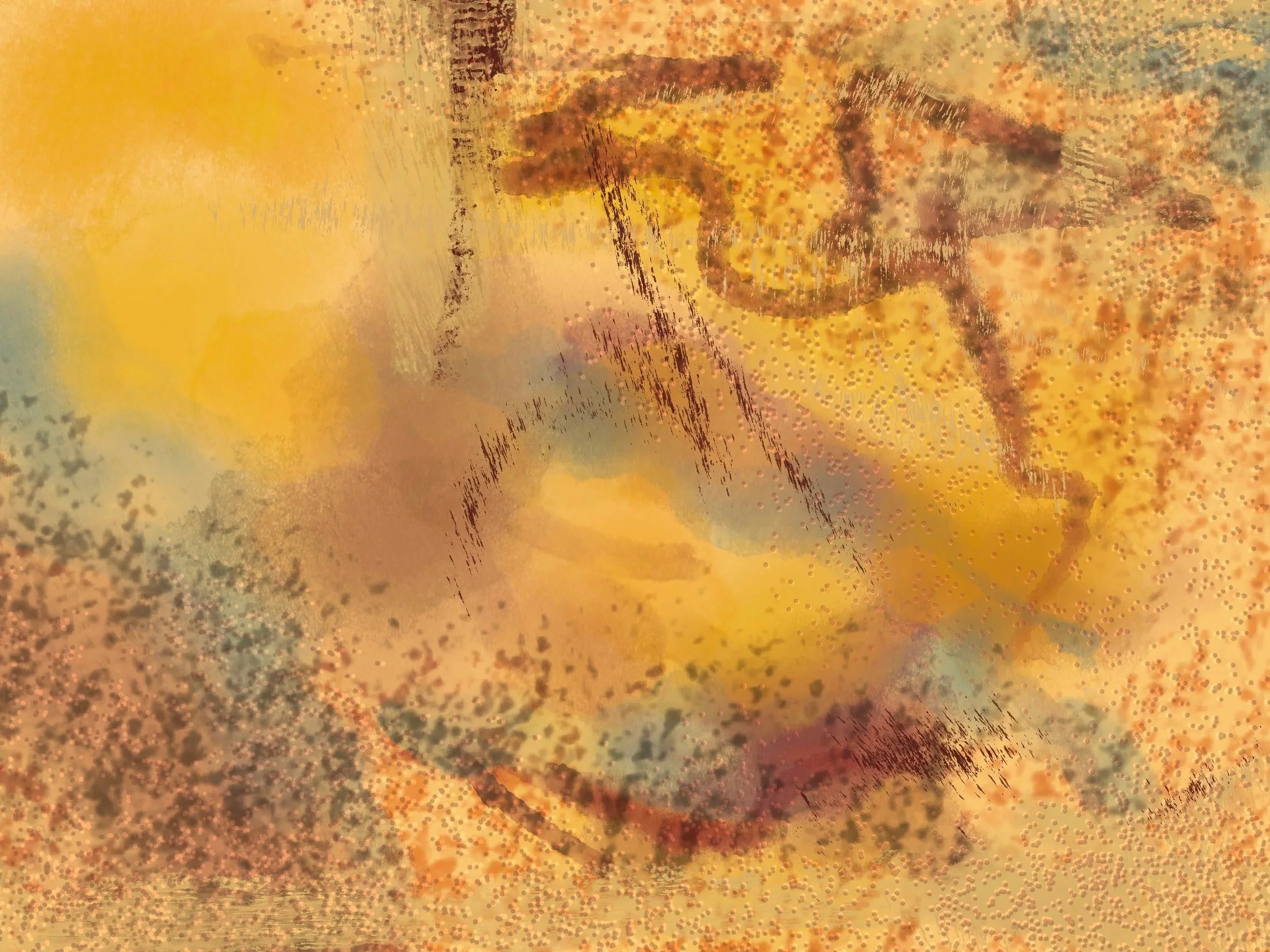
Art by Kelley-Marie Van Dilla
Translator’s Note
As a poet who writes daily in Serbian, Greek, and English, and who has lived between Serbia and Greece for the past eleven years, I am acutely aware of what is gained and lost in the journey between languages—not just words, but worlds. Greece came into my life through love. I decided to make it my home, knowing almost nothing of its tongue. If in Serbia I was born as someone's child and as a poet, in Greece I was reborn as a woman, a mother, and a translator, learning to love and to be loved in an entirely new cosmos of words and tenderness. Linguistically, I was a child once more, forced to grow up all over again.This rebirth taught me that being understood is not a given, but a privilege that we often take for granted in our mother tongue. While the specificities of each culture are its greatest wealth, they can also become a barrier. My work is an attempt to share that beauty beyond its borders—to ensure that the richness of a language does not become a cage, and that no world remains a prisoner of its own words. It is from this place of living between languages that these translations were made.
These poems were written in Serbian—a language dense with the textures of Balkan domestic life, folk tradition, and a particular music that does not translate word for word, but image for image, metaphor for metaphor, idiom for idiom. Take Thumbelina, for example. In Serbian, the Milky Way is called “Кумова слама”—the Godfather's straw—carrying within it an entire folk legend: a godfather who steals straw on Christmas Eve, spilling it across the sky as God's punishment for all to see. While the Milky Way is an astronomical observation, Кумова слама has a moral dimension, too. But the pitchfork had to do all the magic here: in Serbian, it sweeps and swirls the straw, mirroring the circular motion a galaxy makes. In English, that same pitchfork stirs the swirl of the Milky Way—as if churning butter from the cosmos itself. My aim was not merely to render meaning across languages, but to carry the full sensory world of these poems into English: so that an Anglophone reader might not only read them, but smell the ash lye, feel the polished earthen floor, taste the cornbread split from underneath.
Thumbelina is built from objects that carry centuries of rural Balkan life: a dowry blanket, an apron, an Orthodox chandelier (“полијелеј”), ash lye used for laundry. The name “полијелеј” comes from the Greek for ''much oil'', a reference to the hundreds of oil lamps it once held. In Greek, the word has drifted into everyday use and today simply names any chandelier with multiple lights. In Serbian, however, it remains bound to the sacred, carrying its full religious resonance to this day. On the other hand, an Anglophone reader is unlikely to have enough contact with Eastern church tradition to feel its gravity. I chose ''chandelier'' instead, a word that carries light and ceremony without demanding an additional explanation. In doing so, I knowingly reduced the spiritual weight of the poem's closing image. But I trusted that the gesture—a mother lighting up the sky for her child—would carry the tenderness across, even without the religious context. Where direct translation would have required footnotes rather than adding to the poetry, I translated function rather than form—trusting the image to carry what the word once held.
Farewell offered an unexpected gift. In Serbian, “а он би и моје руке за весла” is simply a demand—he wants her hands as oars. But in English, "asking for her hand" carries the ghost of a marriage proposal, an extra layer of meaning that emerged spontaneously in translation. What reads as a moment of cruel irony—a proposal that was never really a proposal—deepens the poem's central illusion: that any of her sacrifice was ever about love. I kept it, gratefully—such gifts of language are not to be refused.
In Rendezvous, sound was everything. The clatter of heels on a dock needed to feel as precise in English as in Serbian—I worked to find words whose sonic texture would pull the reader into the rhythm of that world before the meaning even landed. The poem itself is shaped to sway, its lines offset to mimic the swing of a woman's hips as she walks away, the unsteady staggering of a man, and the rocking of boats at the dock. There are no human voices, only the sounds of objects: the clatter of shoes, the drumming of a heavy sole, the clinking of coins. A key example is the close, “звецка, одобрава,” which became “clinks in approval.” I chose “clinks” because it carries that specific metallic ring that works for both: the coins in her purse and the sound of glasses raised in a toast. It’s the sound of a decision being celebrated, a moment of success. Similarly, “тапшући јој бок” became “applauding against her hip”. In Serbian, “тапшати” can mean both: a pat given to an animal after a job well done and the act of applauding. I chose the latter, drawn by the image of purse and hip rhythmically colliding like two hands clapping.
When it comes to self-translation, translating my own poems is, paradoxically, the harder task. The freedom is boundless—and that is precisely what makes it difficult. The rhythm can carry me in a different direction; I find myself shifting the lens through which I see the poem. With older work, the temptation is even greater: my own perspective has changed over the years, and I am drawn to find new meanings, new layers that were not there before. Translating another poet's work demands a different kind of discipline. There is less room for hesitation, as I am guided by a singular path—either my own interpretation or the poet’s explanation. In that case, I am merely a medium; my task is to ensure a voice that is not mine travels as far as it can. In both cases, though, I must be in love with the poem I translate. I am guided above all by instinct—not by theory or method, but by a certain feeling in the stomach. My approach to poetry has never been scholarly; it is, and has always been, deeply intuitive. I simply let the rhythm lead me. When the poem feels complete, whole, and entirely itself in its new language—I know I have brought it home.
—Jovana Simic Roussou
THREE POEMS
Translated by the author
Thumbelina
Mother,
gather me among the herbs
with thyme
and wild strawberries.
Weave your fingers into a nest
and carry me away.
Bathe me in the river,
whiten me in ash with the laundry.
Cup me in your palm
like a sip of water.
Take me to our home.
Spread out the still-living coals,
split the cornbread with your finger
from the softer side underneath.
Let the crumbs under your fingernail
be my feast tonight.
Unfurl your dowry blanket
on the polished earthen floor;
under my head, fold an apron
with the scent of your lap.
There, let me rest.
Unbraid the roof boards
above the rafters.
With your pitchfork, stir
the Milky Way’s swirl.
Light with a match
the stars as a chandelier.
Farewell
I see his ship off
sailing to the North,
where all women have
auburn hair.
I offer my lungs—
a pair of wings—
to serve him
in place of sails.
I build him a ladder
out of my ribs,
to ease his way
down to Hades.
Greetings I send—
my heart ripped from my chest!
And there he is, asking
for my hand—as an oar!
Let him take my head
with him, just as well!
At least I won’t think
of him; no more!
Rendezvous
A medley of clacks and clops
awakens the river dock.
After a brief encounter
two scatter apart.
The heavy sole keeps drumming
away, toward the wharf.
The stiletto goes farther still,
into the warehouses, deep.
A purse, lightly weighted
by a few coins, clinks in approval,
applauding against her hip.
THREE POEMS
By Jovana Simic Roussou
Палчица
Мајко,
набери ме с биљем,
са твојом душицом
и шумским јагодама.
Исплети прсте у гнездо
па ме собом понеси.
Окупај ме на реци,
избели ме са рубљем.
Захвати ме шаком
као у гутљај воде.
Кући ме нашој поведи.
Разгрни још живо угљевље,
распори погачу прстом
одоздо, где је најмекша.
С оним што под нокат ти стане
вечерас ме нахрани.
Распростри своју спрему
на углачан земљани под,
под главу ми савиј прегачу
с мирисом твог крила.
Ту ме на починак прими.
Растави кров изнад греда.
Вилама разгрни
ковитлац Кумове сламе.
Шибицом је запали,
нек гори ко полијелеј,
све звезде да нам светле.
На растанку
Пратим његов брод
пут Севера,
где су свим женама
косе риђе
Нудим му плућа
као крила,
нека му служе
место једара
и лестве му чиним
од ребара
да с њима лакше
до Хада сиђе
и срце му пратим
из недара!
А он би и моје руке
за весла!
Ето му и главе!
Нек је собом носи –
не бих ли се мисли
о њему отресла!
Састанак
Мешан бат ципела
буди речни док.
Након кратког сусрета
двоје се разбеже.
Тежак ђон добује
према пристаништу.
Танка потпетица даље,
дубоко у складишта.
Ташна, отежала од пар кованица,
звецка, одобрава
тапшући јој бок.
-
Jovana Simic Roussou is a Serbian poet living in Greece. She writes in Serbian, Greek, and English and is the author of four published poetry collections in Serbian, as well as a bilingual Greek–Serbian children's book.
Her work has appeared widely in magazines and anthologies across the Balkans and has received several regional literary awards. Her poetry often explores themes of memory, domestic and communal life, and the quiet rhythms of everyday experience. In translation, she seeks to preserve the emotional resonance and texture of the original language, creating work that speaks across cultures.
Her English poetry has appeared in Trafika Europe and is forthcoming in Mantis (Stanford University), Plume and Blue Unicorn.
-
Jovana Simic Roussou is a Serbian poet living in Greece. She writes in Serbian, Greek, and English and is the author of four published poetry collections in Serbian, as well as a bilingual Greek–Serbian children's book.
Her work has appeared widely in magazines and anthologies across the Balkans and has received several regional literary awards. Her poetry often explores themes of memory, domestic and communal life, and the quiet rhythms of everyday experience. In translation, she seeks to preserve the emotional resonance and texture of the original language, creating work that speaks across cultures.
Her English poetry has appeared in Trafika Europe and is forthcoming in Mantis (Stanford University), Plume and Blue Unicorn.