RESONANCE
A POEM BY BORIS PASTERNAK
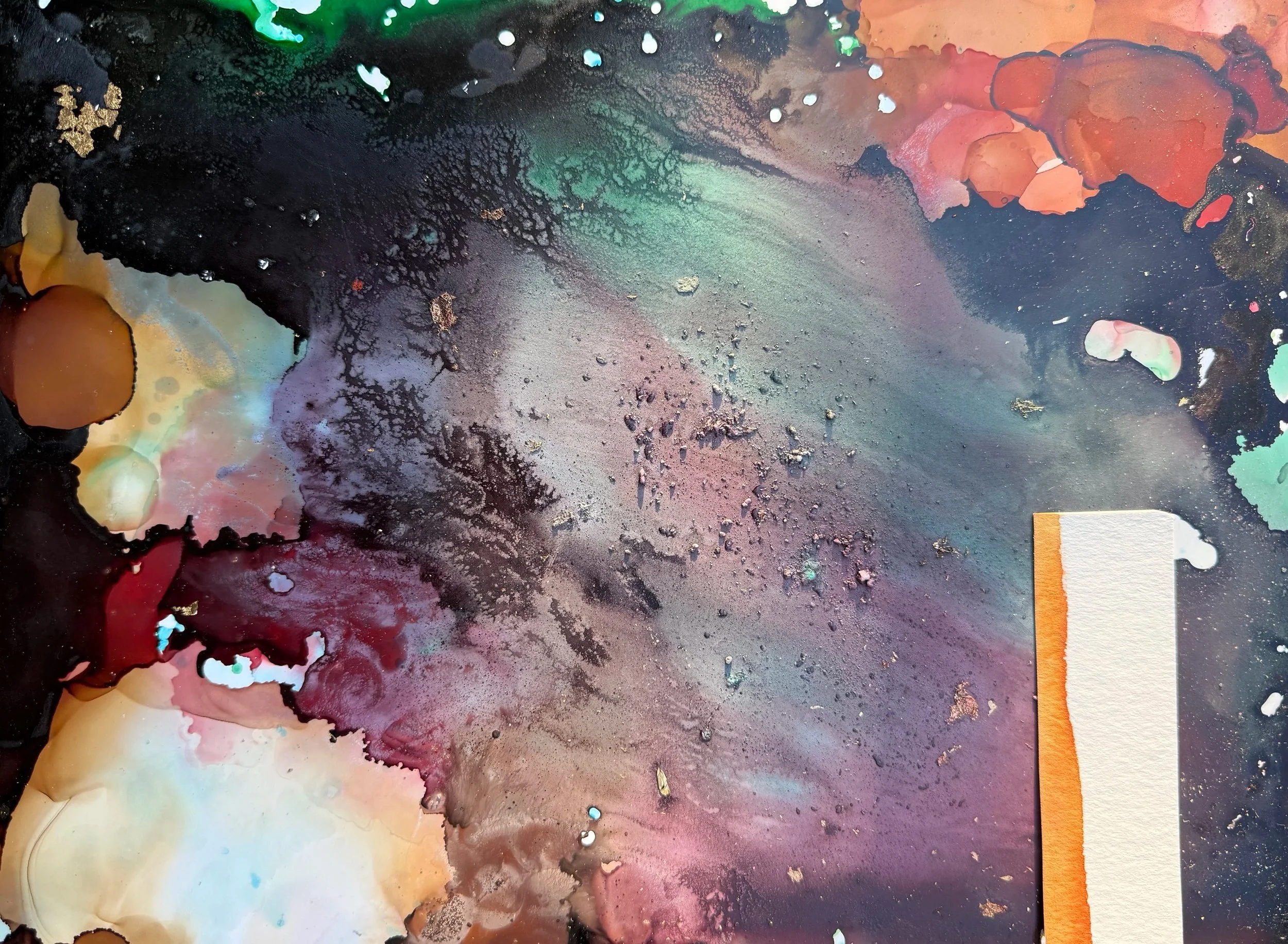
Art by eylül doğanay
Translator’s Note
Throughout my childhood, Boris Pasternak was a household name. Like us, he was a Soviet Jew. Like us, he clutched his intellectualism like a shield, as the world around him burned and crumbled. Pasternak’s language is both ornate (the scattered rowan berries are a “trembling cursive”) and expansive (Jagiello and Jadwiga were a medieval royal couple, responsible for bringing Catholicism to Poland and Lithuania). This made for a daunting, yet gratifying challenge.
Most striking for me was this poem’s year of publication. For Russia, 1917 was a year of the czar’s abdication, followed by two revolutions, and the start of a civil war. In its midst, Pasternak wrote of leaves, of rain, of love, and of divinity (though also of tombstones and of the pitch-black afterlife). I imagine this poem was his life raft. His remarkable ability to turn to beauty in the midst of chaos is an admirable trait, no less applicable in our time.
When translating formal verse, I strive foremost to preserve form and musicality. I map out the rhythm and meter for the entire poem, then do my best to preserve fidelity within those constraints. At times, this leads me to swap lines within a stanza, especially since English tends to place verbs after subjects, whereas Russian offers a poetic abundance of word-order possibilities. In a few cases here, I opted for fluency. For instance, “caryatides” is truly difficult to pronounce, let alone to rhyme, so I translate it as simply as “statues.”
Many hours went into trying to pin down the meaning of the word zga in the original. A path? A spark? We know that pitch darkness is described in Russian as “not being able to see a single zga,” which was of little help here. So I contend that Pasternak’s “I know not whether the mystery of the zga beyond the grave is solved” is close enough to my “I doubt we know at all / the afterlife’s incentive.” But I will have to wait until I meet him to know for sure.
—Liya M. Akoury
ONE POEM
Translated from Russian by Rachel Britton
Almighty God of Love
My friend, you’ll ask me, who ordains
The fiery speech of a holy fool?
Let’s litter our words,
Just as the gardens scatter,
So freely, zest and amber,
Almost, almost, almost.
No need to wonder why
The leaves, with such decorum,
Are splashed with lemon aurum
And with rose madder dye.
Whose tears soaked the pines,
Who flooded, through the roof brace,
The music sheets, the bookcase,
Right through the sluice of blinds.
Or who, beyond the doors,
Blackened the rug with rowans,
A draught upon a canvas,
A fluttering scrawl of words.
You’ll ask me, who ordained,
For August to be great,
For whom no thing is tiny,
Who is immersed entirely
Trimming a maple leaf,
And since Ecclesiastes
Is yet to be relieved
From carving alabasters?
Who, in September, wills
The lips of every aster
And dahlia to suffer?
So that the willow leaves,
From graying statues, tumble
Onto the wet, autumnal
Tombstones from past regimes?
You’ll ask me, who commands?
- Almighty God of details,
Almighty God of love,
Jagiello’s and Jadwiga’s.
I doubt we know at all
The afterlife’s incentive,
But, like the hush of fall,
Existence is extensive.
THREE POEMS
By Arndís Lóa Magnúsdóttir
Всесильный Бог Любви
Мой друг, ты спросишь, кто велит
Чтоб жглась юродивого речь?
Давай ронять слова,
Как сад - янтарь и цедру,
Рассеянно и щедро,
Едва, едва, едва.
Не надо толковать,
Зачем так церемонно
Мареной и лимоном
Обрызнута листва.
Кто иглы заслезил
И хлынул через жерди
На ноты, к этажерке
Сквозь шлюзы жалюзи.
Кто коврик за дверьми
Рябиной иссурьмил,
Рядном сквозных, красивых
Трепещущих курсивов.
Ты спросишь, кто велит,
Чтоб август был велик,
Кому ничто не мелко,
Кто погружен в отделку
Кленового листа
И с дней экклезиаста
Не покидал поста
За теской алебастра?
Ты спросишь, кто велит,
Чтоб губы астр и далий
Сентябрьские страдали?
Чтоб мелкий лист ракит
С седых кариатид
Слетал на сырость плит
Осенних госпиталей?
Ты спросишь, кто велит?
- Всесильный Бог деталей,
Всесильный Бог любви,
Ягайлов и Ядвиг.
Не знаю, решена ль
Загадка зги загробной,
Но жизнь, как тишина
Осенняя,- подробна.
-
Most famous abroad for his novel Doctor Zhivago, at home, Boris Pasternak is known just as much for his poetry. His translations of Goethe’s and Shakespeare’s plays into modern, accessible Russian are truly foundational works. Born in 1890, he witnessed the Russian Empire become the Soviet regime. Once at the center of Moscow's literary circle, he would eventually lose most of his friends (Mandelstam and Tabidze to the Great Purge; Tsvetaeva and Iashvili to suicide). Pasternak himself narrowly escaped arrest and likely eventual death. In 1937, he refused to co-sign a statement condemning two enemies of the state. Perhaps apocryphally, Stalin spared him from execution, stating, "Leave that holy fool alone." Pasternak was awarded the Nobel Prize in literature in 1958, but declined it, following a smear campaign and threats of deportation. He died at 70, in his summer home, in the company of his sons.
Uroš Bojanović was born in Teslić, Bosnia, in 1991. He has published four collections of poetry. English translations of his poems have been published or are forthcoming in Asymptote Journal and Exchanges. His original poems have been published in Balkan literary magazines like ARS, Kritična masa, Zarez, Tema, Polja, Strane, Poezije, and Fantom slobode. Additionally, his work was included in an anthology of Balkan poets called Soft Tissue. Bojanović lives in Belgrade, Serbia.
-
Liya M. Akoury (nee Liya Markovna Rakhkovskaya) was born in Leningrad, USSR (now Saint Petersburg, Russia). She currently lives in Northampton, Massachusetts, where she works as a clinical psychologist by day. By night, she is also a poet, a speculative fiction writer, and a translator of Russian poetry. Her poetry appears in Rattle magazine and the Blue Unicorn, and her flash fiction in 365 tomorrows. Having witnessed the end of democracy in her homeland and seeing dictatorial patterns likewise emerge in her new home country, she agrees wholeheartedly with Meena Alexander: “We have poetry so we do not die of history.”