RESONANCE
THREE POEMS BY ARNDÍS LÓA MAGNÚSDÓSTTIR
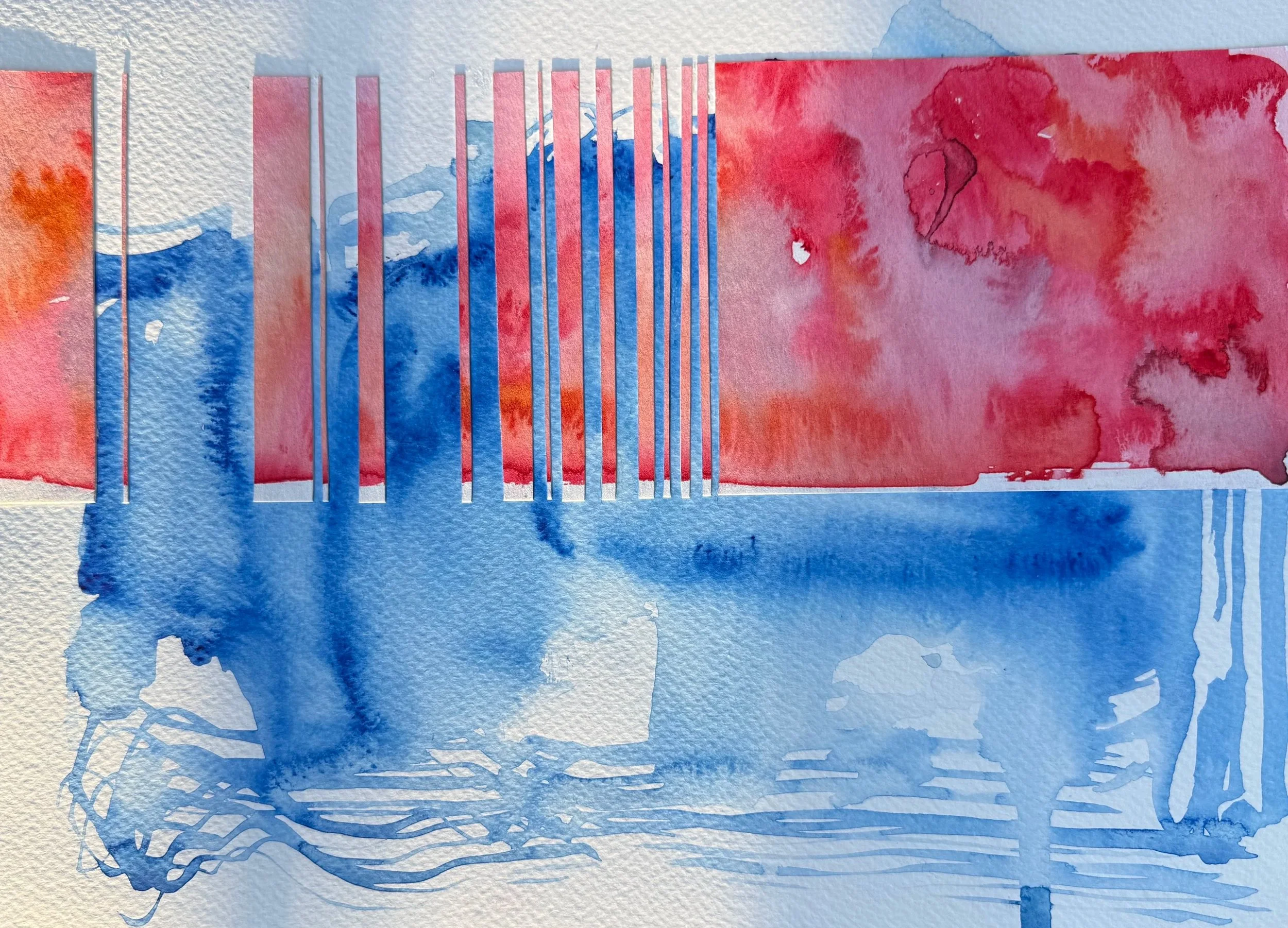
Art by Kelley-Marie Van Dilla
Translator’s Note
These poems are excerpted from Arndís Lóa Magnúsdóttir’s first book, Taugaboð á háspennulínu (Nerve Impulses on the High-Voltage Power Line), which is forthcoming from Saturnalia Books in English translation. It comprises two long, numbered poems that examine human language, and the various forms it can take, as adaptation for survival. The poems intertwine the stories of a child born without the ability to speak and an elderly cruciverbalist who is starting to lose his linguistic acuity. In the space between language, the electric impulses that crackle between neurons produce alternative methods of communication, and other ways of expressing oneself and navigating the modern world.
Arndís writes that “sound is air vibrating / when it meets the world’s / resistance”. In these poems, words peal like chimes and their sounds refract as they travel through different mediums: ocean waves, tongues, languages. Through translation, the new sounds resemble the originals, but have echoed into difference: “muldra” becomes “mumble,” “drafa” becomes “drawl.” I imagine the words coursing through the salty sea air over the North Atlantic, their molecules quivering in the turbulence south of Greenland, splitting into particles that might sound familiar in other languages.
As a non-native Icelandic speaker, I was drawn to Arndís’ willingness and ability to play with the language and its sounds. The first time I read this book, I had only just moved to Iceland and was learning the language. To practice my pronunciation, I would read the poems aloud and learn the shapes my mouth needed to make to produce the right sounds. Not only did this improve my pronunciation, but it also made me understand the role that sound plays in these poems. In the Icelandic poetry tradition, the repetition of sound is a defining feature—one might venture to say a high-voltage power line threaded through each stanza. In the first poem included here, for example, Arndís writes:
“á meðan þú sleikir
saltar skrámur
leitar hann
í bókmenntir eftir svörum”
Here, the s in “sleikir” threads into “saltar,” “skrámur,” and “svörum.” Meanwhile, the ei sound in “sleikir” reaches down into “leitar.” While this is not always possible in English, the translation attempts to evoke this continuity of sounds:
“as you lick
your salted scrapes
he scours
literature for answers”
My translation links “scrapes” across lines and in several directions with “salted” and “scours” through its s and the crisp sc that even reaches up to the ck sound in “lick,” which slithers back down the li to “literature.” The musicality of Arndís’ poetry reverberates off the tongue and through the sinews, proving that language is not only cerebral but a physical inhabitance.
—Rachel Britton
THREE POEMS
Translated from Icelandic by Rachel Britton
wager the world
on all fours
the living room carpet’s bid
one hundred percent wool
brightblue like a bruise
your tongue is tied in barbed wire
all around messages peal
from the thesaurus
the cruciverbalist
finds the names of all sounds
shrinks them into
chimes and hangs them over the bed
mumble
splutter
warble
drawl
as you lick
your salted scrapes
he scours
literature for answers
finds the inarticulate and impedimental
Ancient Greek
Demosthenes
who stuffed his maw with stones
and screamed at the surging sea
demanding answers
the sea screamed back:
say she sells seashells by the seashore
ever since
you’ve collected rocks
and filled your mouth with them
sound is air vibrating
when it meets the world’s
resistance
a word tastes
like a weighty, metallic
aerophone
THREE POEMS
By Arndís Lóa Magnúsdóttir
leggur veröldina undir
á fjórum fótum
í boði stofuteppis
úr hundrað prósent ull
fagurblátt eins og marblettur
um tunguna liggur gaddavír
allt um kring óma skilaboð
úr samheitabók
krossgátusmiðurinn
finnur öllum hljóðum nöfn
smækkar þau niður í
óróa og hengir yfir rúmið
muldra
tafsa
kvaka
drafa
á meðan þú sleikir
saltar skrámur
leitar hann
í bókmenntir eftir svörum
finnur Forn-Grikkja
óskýrmæltan og málhaltan
Demosþenes
sem tróð steinum upp í góminn
og öskraði á úfið hafið
krafðist svara
hafið öskraði á móti
segðu þrettán þjófar þjösnuðust á þakinu
upp frá því
safnar þú steinum
fyllir munninn af grjóti
hljóð er loft sem titrar
þegar það mætir mótstöðu
heimsins
orð bragðast eins og
níðþungt blásturshljóðfæri
úr málmi
-
Arndís Lóa Magnúsdóttir is a writer and translator from Reykjavík. She holds a BA in French and Literature, as well as an MA in Translation Studies, from the University of Iceland. She has published two books of poetry, Taugaboð á háspennulinu and Skurn, as well as translations from French into Icelandic.
-
Rachel Britton is a writer and translator from New York, based in Iceland. She holds a BA in English and Creative Writing from the State University of New York at Geneseo and an MA in Translation Studies from the University of Iceland. She has received support from the Fulbright Commission, the American-Scandinavian Foundation, the Árni Magnússon Institute for Icelandic Studies, and the Icelandic Literature Center. Her translation of Brynja Hjálmsdóttir’s A Woman Looks Over Her Shoulder was published in 2024 by Circumference Books.