Review: Journey to the Edge of Life by Tezer Özlü
Translated by Maureen Freely
Review by Doğa Ayar
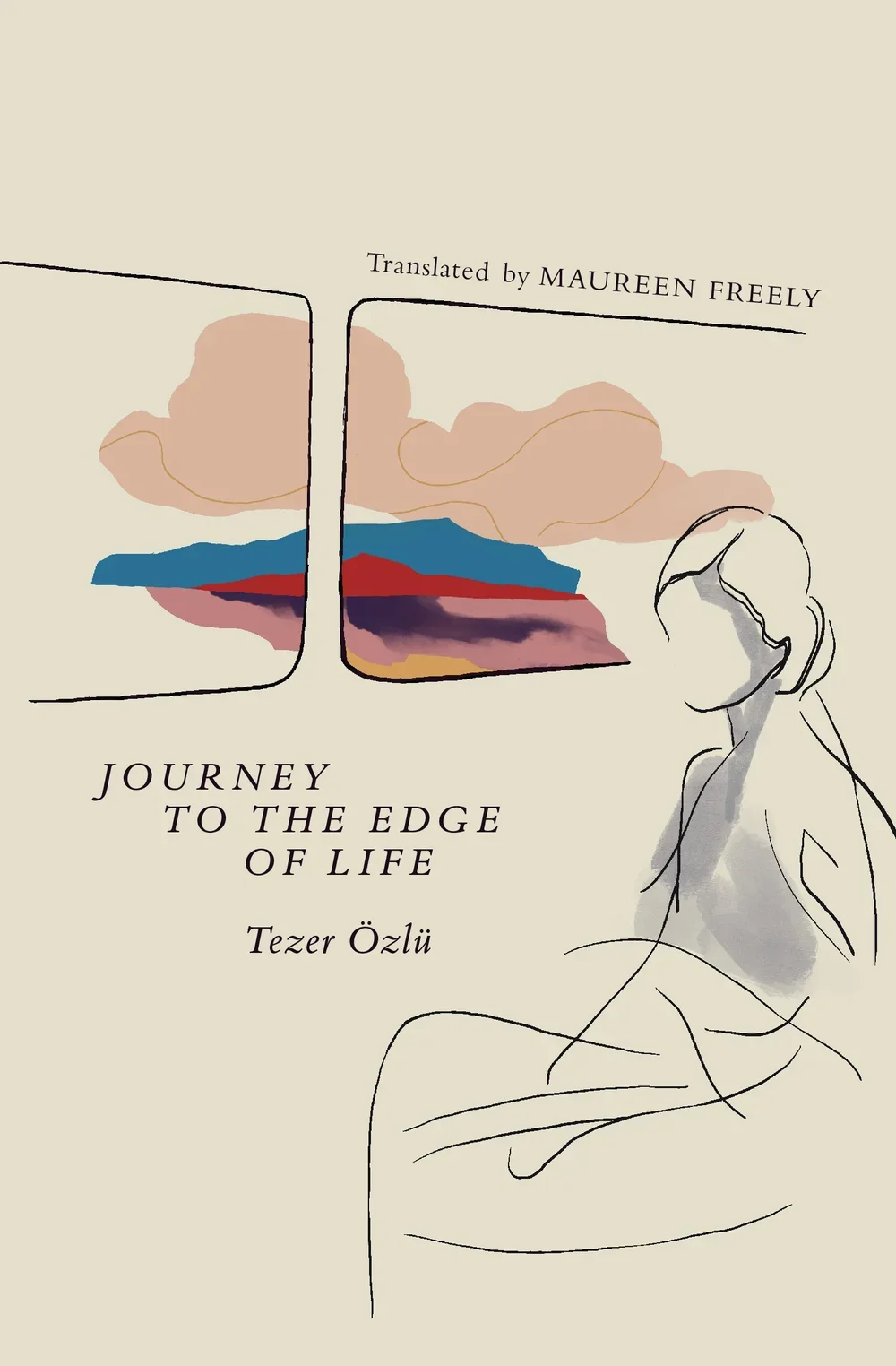
Transit Books, 120 pages, $19 paperback
Journey to the Edge of Life is a metaphysical travelogue narrated by a woman in constant motion, repeatedly crossing boundaries and losing and reassembling herself along the way. Tezer Özlü first wrote the book in German and later translated it into Turkish in 1982; it received the Marburg Literary Prize the same year. This opened a new path in Turkish literature. Migrant literature, especially following the 1961 Turkish–German Labor Agreement, often centered on loneliness as an inevitable consequence of language barriers, exclusion, and longing for a homeland. Özlü, however, follows a writer who travels continuously across Europe for extended periods. She portrays migration not as mere displacement, but as a process of confronting oneself in an existential tailspin.
For the nameless narrator, the drive toward individuality is repeatedly dampened by abandonment, and writing becomes a space of resistance. The journey is not an escape but a form of existence that deepens loneliness, in which trains, hotels, and cities symbolize transience, the condition of being nowhere. Thrownness is the only constant, regardless of loving or being loved, standing in a crowd, or writhing alone in a room with a toothache. Only the writer hears what is written, reinforcing that writing does not eliminate loneliness but instead names it. Özlü’s tone flourishes in an introspective language that resists expectation. The narrative offers neither resolution nor active resistance; instead, it embraces incompatibility as its stance.
Despite this, Özlü is often pigeonholed as a spokesperson for confessional literature from a certain generation, even as a book has never gone out of print in Turkey. To understand how she universalizes suffering—transforming incompatibility from a deficiency into a conscious mode of existence in which the loss of representation initiates freedom—it is crucial to consider her investment in a particular form of writing: translation.
The narrator is deeply affected by the life and works of Cesare Pavese, whom she translates. His biography becomes a mirror for the novel’s protagonist, prompting a process of self-scrutiny through a pilgrimage to the places he once inhabited. For the narrator, to live is to leave cities, countries, marriages, and institutions; without a stable place, time, or identity, Prague, Trieste, and Turin merge into a single mental cityscape. Translation thus becomes the act of infusing hope with action: rewriting with a guide who always exceeds the point of departure, where every return to the origin moves one step further away from it. Where Adorno ends his fragment on writing with “Ultimately, the writer has no place left to live, not even in their own writings,”[1] Özlü picks up with:
“I have no choice but to return to the words I have kept inside me, carried with me, lived and breathed. How did I ever endure this sky without my words? How did I endure that avenue, that night, those nights when I lay sleepless in bed, my thoughts racing—unable, when I rose, to translate them into words? When at night, in the depths of a deadly sleep, I confronted existence and found it so very small. This life satisfies me only when I have taken the lonely wind that blows inside me, the love that loves inside me, the death that dies inside me, and my very will to live, and turned them into words.”
Accordingly, the book metaphorizes the question of whether confines, from the Berlin Wall to the yellowed wallpaper of motels, that grow alongside the individual can be internalized. These boundaries both encompass self-worth and prevent the individual from fully becoming who they are. Translation offers a means of rejecting a society that can represent only what it already possesses. Beyond the narrator’s profession, translation operates at the level of narration itself. The novel renders Turkish accounts of conversations overheard or reluctantly conducted in German, Italian, and English. Writing becomes a confrontation with life and death, its value grounded not in readership but in honest engagement with others.
The narrator voices hope through a fantasy of discovery, which Özlü shapes into a female figure who insists on freedom, making femininity a site of resistance and subject formation. Hope emerges as the sense that another life is possible, pursued across horizons that translation brings together. Translator Maureen Freely distills these layers of translation into lucid English. One of the most striking differences is the use of the pronoun “he,” which Turkish omits to preserve ambiguity. While the man in the narrator’s life becomes more explicit, Freely maintains the narrative’s blurring of subject boundaries, particularly in the compulsion to please both herself and him by constantly moving from place to place. The self fragments and reassembles through naming and recognition, and Freely reclaims the “I” through fragments, showing how the woman internalizes and confronts her position as the Other.
The traces of Kafka, Svevo, and Pavese form a framework through which literary memory intertwines with autobiography, and the novel’s translatedness makes writing itself the central creative act. Freely is especially adept at conveying Özlü’s desire to remain outside in parks, boulevards, cafés, and squares, insisting on presence in public space while keeping inner life alive. This spatial interweaving, in which the narrator walks alone, freely going and returning, renders the world as one’s own estate, much as translation detaches and reattaches narrative to moments rather than to a single source or partner.
Journey to the Edge of Life is often framed as a text that speaks for women, but when reread through the lens of translation, it reveals itself as a work that transforms displacement into agency and makes hope inseparable from the act of rewriting one’s existence.
[1] Minima Moralia, fragment 51
-
Doğa Ayar