Review: If This Be Magic: The Unlikely Art of Shakespeare in Translation
by Daniel Hahn
Review by Andrea Avey
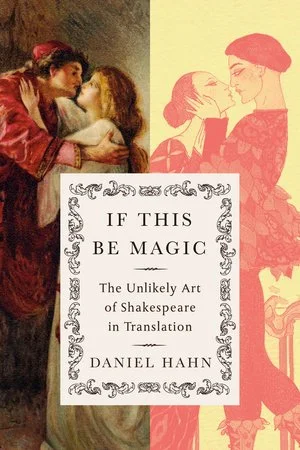
Penguin Random House, 416 pp., $35 (hardcover)
In chapter one of his latest book, Daniel Hahn sums up the translator’s job: “to change absolutely nothing about [a] piece of writing—except, of course, for all the words.” To translate is to do the impossible. To read, notice, and understand the essence of a text and bring it into a new language and a new context for a new audience. This is always a unique challenge, but do certain projects offer more fearsome challenges than others? What about when translating a hypercanonical author like William Shakespeare? This is the question Hahn explores at length, supported by a diverse cast of fellow translators, scholars, actors, and directors.
Hahn titles his chapters with lines from various Shakespeare translations (dutifully cited and attributed to their respective translator[s] in an appendix), though each also bears a parenthetical subtitle identifying specific translatorly concerns: ambiguity and wordplay, verse, word order, research, etc. While these concerns can apply to any given translation project, Hahn keeps the focus on the Bard and demonstrates how these priorities manifest in the practices of the translation ensemble he engages with throughout the book. Some of the main supporting roles are played by Danish translator Niels Brunse, Portuguese translator José Francisco Botelho, French translator Jean-Michel Déprats, Hungarian translator Ádám Nádasdy, Māori translator Te Haumihiata Mason, and Japanese translator Shoichiro Kawai, among many others. Hahn is our emcee, guiding our readerly attention from one example and language to another, ushering us from a line of Welsh to another in German, eager for multilingual immersion. If This Be Magic is concerned less about seamless transitions and more about showing that literary translation is hard, especially when seeking to be on a par with a writer as intimidating and awe-inspiring as Shakespeare—a feat the book’s examples repeatedly reveal to be successful.
One of the book’s central theses is that specificity matters. Any translator knows that context is everything, and Hahn takes great care to illustrate how the featured Shakespeare translators have kept that top of mind. As in any translation, a translator often must “change things in order to keep things the same”—what those things are depends on the translator and their priorities. Hahn reiterates that the Shakespearean texts embraced by the Anglosphere exist in the form they do because the playwright was using the tools afforded him by the language. Rhythm, humor, rhyme, and register appear in English as they do because of the available affordances and flexibilities of English. Translators of Shakespeare then should be empowered to do the same with their respective target languages. It can still be Shakespeare if it’s not written in blank verse (unrhymed iambic pentameter), especially if, for example, the alexandrine (12-syllable line with a caesura in the middle) produces a similar literary and emotional effect, as it can for a French audience.
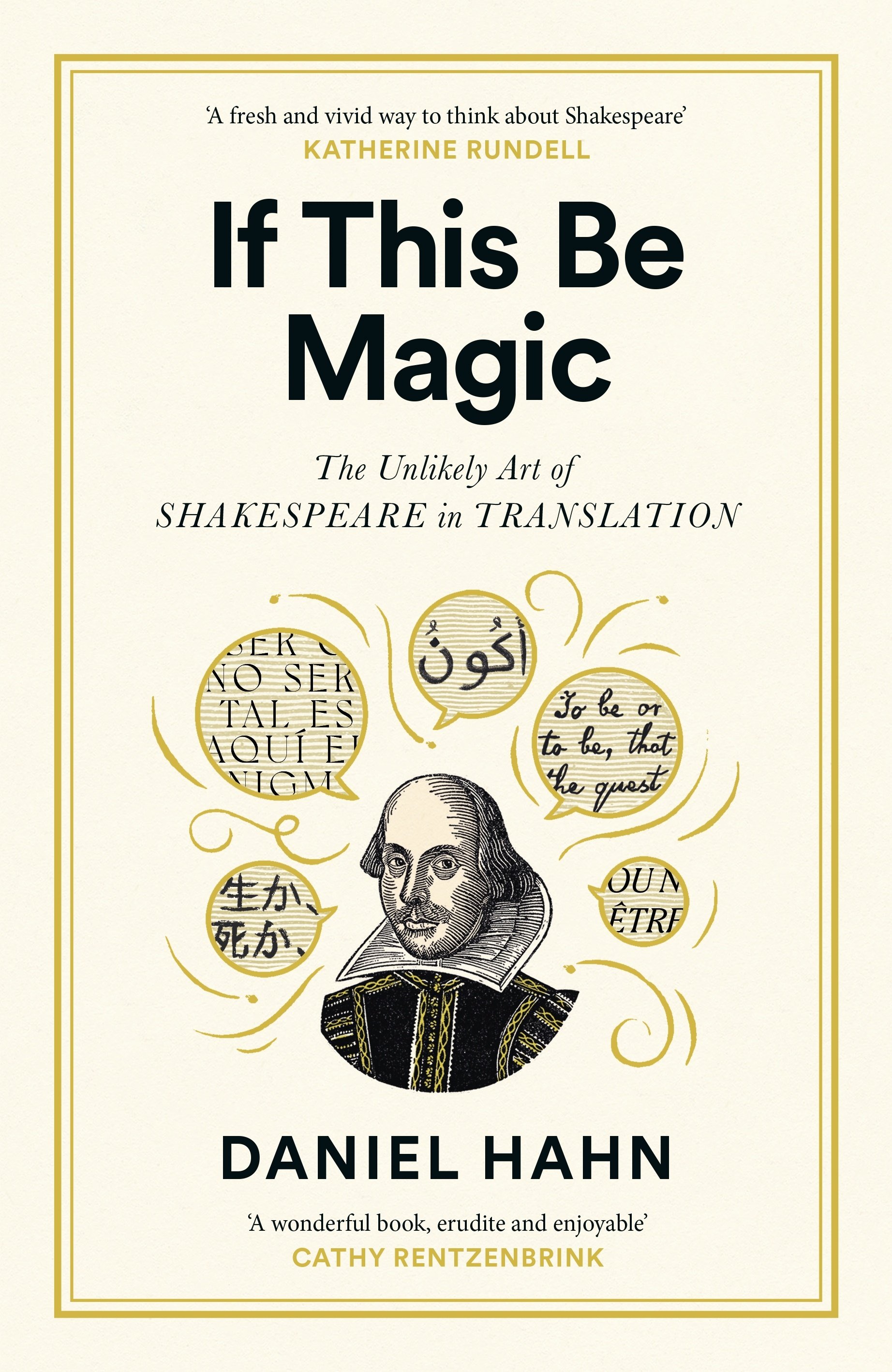


Deciding what facets of the language should be privileged above others depends on what the translator wants to retain and recreate in their translation. As Hahn says in one of the many bons mots scattered through the book, “Sometimes a translator is not principally concerned with the thing, but its function.” The idea of equivalent function and effect is crucial when moving between languages, even Shakespeare’s, but his translators must consider medium in addition to context. In English-speaking education, we often view the Shakespearean text on the page and evaluate it for its intellectual rigor, prestige, and reward, but it’s crucial that translators of Shakespeare (English-speaking or otherwise) remember his intended context: the playhouse before a live audience, with words scripted for actors to use, interpret, and inflect accordingly. Thus, if Quince in A Midsummer Night’s Dream speaks a malapropism meant to elicit a laugh, a mix-up of a similar sort, perhaps the
Hungarian “heroikus” that combines “heroic” and “erotic,” is an effective translation for an equivalent effect. The Shakespearean translator must consider the dimension of performance when weighing tone, meaning, punctuation, and all the rest. As Ton Hoenselaars writes in Shakespeare and the Language of Translation, the theatre maker’s primary goal is “not the communication of the literal meaning of the original text, but the re-creation of the theatrical experience embodied there.”
Much of what works about this book comes from the strength of its characters: Hahn, with his characteristic gregariousness, and the translators and interlocutors in conversation with him and the plays. When faced with translation skeptics or those who vaunt “fidelity” (however they may define it) and thus translation as traitorous, this book feels like a sort of vindication of the craft of translation—not to mention the slippery concept of a Shakespearean “original.” But what I see in it most of all is a celebration of the impossible-yet-continually-made-possible work of translation and the brilliant writers who dedicate themselves to it. Each of the individuals Hahn features affirm the power and breadth of language. Part of why Shakespeare’s works enjoy such status is because in them, he pushed the boundaries of English. He stretched its capabilities, introduced neologisms, manipulated its sonic qualities and structural effects for his own purposes. This is precisely what translators do. We’re interested and invested in increasing the capaciousness of our languages. We make them nimble and use that expansiveness not only for its artistic and aesthetic delights, but also for its political and social impact.

Until almost the book’s very end, Hahn defers the bogeyman of AI. He doesn’t arrive at a satisfactory place in his discussion of the interactions between AI and translation, maybe because there is no satisfactory place for the twain to meet. For most of us, I hope, “the humanity is the point.” In artistic endeavors like translation and theatre, witnessing a collective effort of presence, attention, and creativity is the beauty and magic of the artform. The inimitable factor is the human touch, the interpretation, even the mistakes that reveal our inescapably imperfect natures. As Hahn asserts, “The fact that multiple translations exist, each processed through a different human brain (and body, set of experiences, idiolect, etc.), is a thrilling feature of translation, not a bug.” Just as the context of a source text is paramount, so too is our own translator’s posture. “We translate in a moment, and from a human position,” and that singular moment in time—composed of our mood, our environment, what we’ve been eating and reading and contemplating, and our understanding of a text—is the lens through which our readers meet a new translation.
In his book If This Be Treason, Gregory Rabassa describes the phenomenon of a reader’s encounter with a text as initiated and mediated by the translator, the way the playgoer’s experience is initiated and mediated by the actors, designers, and director. These encounters are specific and embodied and can’t be replicated, only made new in their afterlives. Hahn’s book exemplifies this, introducing numerous individuals and their personal responses and approaches to translating Shakespeare’s work. Rabassa’s title serves as a useful touchpoint for Hahn’s own—If This Be Magic—itself a quote from Shakespeare’s The Winter’s Tale. The titles’ conditional constructions position the books’ content to supply an answer to the dangling question. If translation be treason, what do we make of it? If translation be magic, where does that leave the source? I might suggest that if translation is anything, it ought to be human, an artifact of a collaborative experience that reflects our perspectives, resonances, and sparked curiosities. If translation is anything, let it be a magical alchemy between author and reader, translator and text, body and mind, page and stage.
-
Andrea Avey is a writer, dramaturg, and literary translator from Spanish with a focus on Argentine Spanish. She is drawn to projects that allow her to explore how space, place, and thing function as a capsule of feminine identity and memory. She received her MA from the University of Chicago and her MFA in Literary Translation from the University of Iowa.