Review: Perfection by Vincenzo Latronico
Translated by Sophie Hughes
Review by Emma Murray
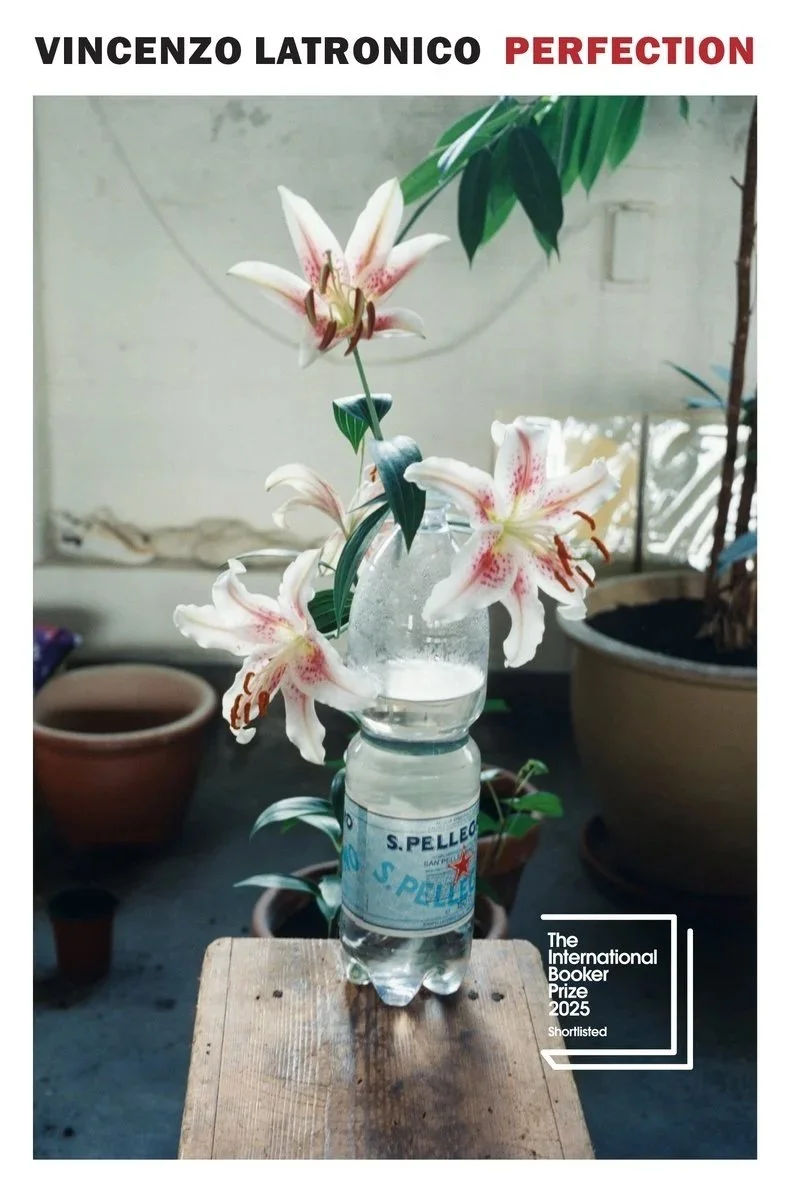
New York Review of Books, 136 pages, $16 paperback
Throughout Vincenzo Latronico’s hypnotic novel Perfection (2025), translated from Italian by Sophie Hughes, the universal is specific and the specific is universal. Anyone reading this can read Latronico’s opening line, “Sunlight floods the room from the bay window, reflects off the wide, honey-colored floorboards, and casts an emerald glow over the perforate leaves of a monstera shaped like a cloud,” and feel a mind-image materializing, coloring itself in: an Instagram-worthy apartment in a Western city filled with trendy Scandinavian furniture, clean lines, white walls.
Set primarily in Berlin, Perfection follows two expats, Anna and Tom, who work as “digital creatives” on freelancing schedules that enable them to explore Europe, engage in local arts, and choose which personal politics to enact. From the outset, there’s a sense of unease that surrounds this easily romanticized life, as the novel’s frank portrayal and Hughes’ precise delivery of Anna and Tom’s inner and outer worlds stimulate Perfection’s core questions: Are the aesthetics that surround us products of us, or are we products of it?
At a dinner party in Iowa City this winter, my friend Tabatha nodded feverishly as I mentioned Perfection’s mesmerizing thrust, the propulsion of which comes not from its scenes or specific tensions, but from its mode of delivery: “It’s told completely in habitual tense,” Tabatha said.
“There’s no dialogue,” I added.
Instead, swirls of moments are grounded by Hughes’ and Latronico’s meticulous curation of words. As Anna and Tom cycle through attempts to find meaning in life, at one point they stumble upon cooking:
“They favored simple ingredients whose flavors they could elevate with the right preparation, just as the white enamel plates could bring out the gold-studded purple of a carmelized beetroot. Their interest hadn’t been planted by sly marketers, but appeared as if by osmosis, as they observed the little differences all around them. It was part of their quest for freedom and pleasure—the pleasure of eating, chiefly, but also the tactile pleasure of cooking slowly, and the visual pleasure afforded by the perfect plating.”
Here, Hughes takes Latronico’s keen eye for detail and delivers three well-paced sentences that exemplify the translation’s movement through grammars of tense and time. Using alliteration, parallelism, repetition, and precise punctuation, Hughes guides readers between specifics (“simple ingredients,” “gold-studded purple,” “carmelized beetroot”) and universals (“all around them,” “quest for freedom and pleasure”) and back to specifics (“tactile pleasure,” “visual pleasure,” “the perfect plating”), creating the timelessness Latronico can more readily access with Italian’s use of the present simple tense for both current and habitual actions; English, by contrast, separates them, as in “I eat” and “I am eating.” Through Hughes’ literary delivery, momentum is maintained while clarity is provided.
Perfection, short-listed for the 2025 International Booker Prize, is Latronico’s first novel to be translated into English as well as Hughes’ first translation from Italian. “Something about the precision of Perfection’s descriptions and the level of detail meant there was a lot of time-consuming rationalising happening all the way through,” Hughes said in an interview with The Booker Prize Foundation. “It helped a lot that, despite not having met Vincenzo in person, I got to work closely with him.”
Both author and translator share a love for small details, knowing that over an entire novel, the “seemingly inconsequential changes” can hold the most importance when reconstructing style in another language. As Hughes told Words Without Borders: “This translation was born lucky—with an author who supports a notion of translation as interpretation, it had every chance of flourishing.” And flourish, it has, as the count of readers continues to rise in the list I like to keep of friends who borrow my copies of books. As one scribbled on the last page: “You never lose sight of what’s above or below the surface in this book. You’re everywhere and nowhere. I loved it.”
-
Emma Murray is a co-editor-in-chief of Exchanges. To see more of her work, see https://emma-athena.notion.site/.