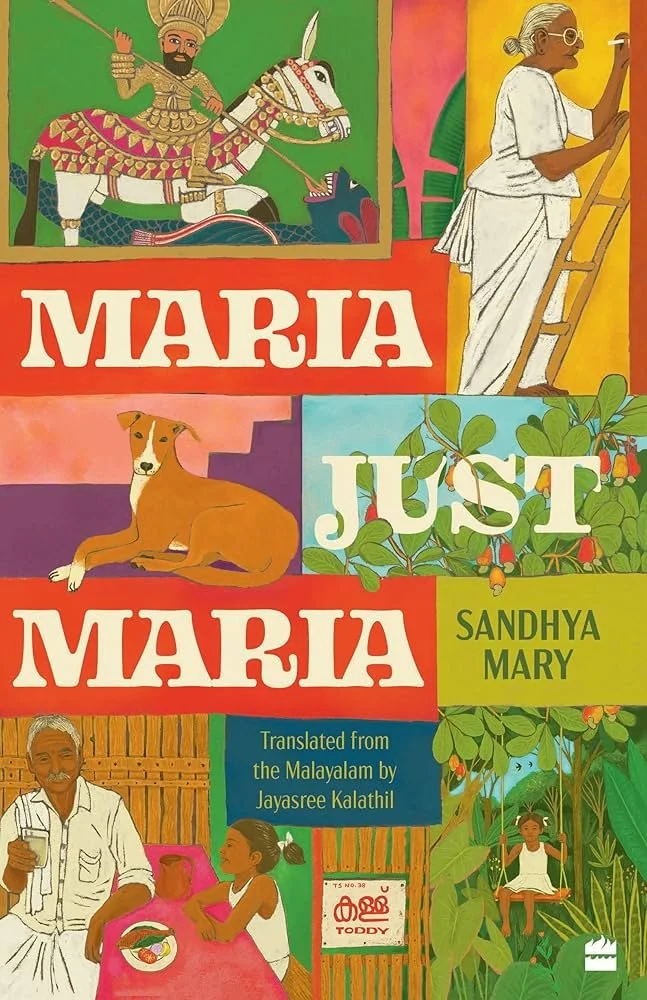
Review: Maria, Just Maria by Sandhya Mary
Translated by Jayshree Kalathil
Review by Vandana Nair
HarperCollins India, 244 pages, $29 paperback
The closest encounter I’ve had with a mad person was with Fajlu, a homeless man who lived on the street facing my grandfather’s home. He had no possessions. His clothes were worn and filthy; his hair and beard, unkempt. He sat leaning against the wall, mostly quiet, only looking alert when Lala, the tea vendor whose stall was on the same street, fed him biscuits and tea. As kids, we’d try to go near Fajlu but we'd squeal and scatter, terrified, when he frowned, squinted his eyes, stuck out his tongue, or brandished his stick like a sword to scare us away. Reading Sandhya Mary’s debut novel, Maria, Just Maria (2024) translated from the Malayalam by Jayshree Kalathil, conjured these childhood memories I’m not very proud of. Maybe he was not mad; maybe some foolish kids like me, who did not understand madness, drove him mad.
What drew me to Maria, Just Maria, is its unapologetic interest in madness—Maria’s scatterbrained, neglected-child madness, her grandfather, Geevarghese’s toddy-induced madness, Anna Valyamma’s dementia-induced madness, her dog Chandipatti’s philosophical madness, Mathiri Valyammachi’s prophesying madness, within the Syrian Christian community of Kerala where strict codes of gender, religion, and propriety carry their own derangements. It pits these atypical mental states against societal expectations, where they provoke fear, avoidance, or laughter—until that laughter turns uneasy, and the questions of who or what defines normalcy become unavoidable.
The novel begins when Maria falls silent after the death of her grandfather, Geevarghese. As a result, she is placed in a psychiatric hospital to “reconnect with reality,” which initiates her fragmented recollections of growing up as “just Maria” in a Syrian Christian family in Kerala, not with her parents but with her grandparents. Her grandfather, Appachan, is the emotional and spiritual anchor of her life. The narrative moves back and forth in time, piecing together Maria’s childhood, family, and memories, often blurring the lines between reality and inventions of a scattered mind. Maria’s accounts of her “Papa, Mama, siblings” highlight her parents’ abandonment of a less-than-perfect child. Despite her silence and unreliable, fragmented recall, Maria’s point of view becomes the boldest device in Sandhya Mary’s writing as it forces us to question what is real, what is imaginary, and whether her “madness” is just another way of resisting conventionality.
The readers experience Maria’s inner world through her broken recollections of adventures with her grandfather around their ancestral home, Kottarathil Veedu, and their village, lush with greenery, rivers, and fields as fertile as her mind, where the rhythms of land often mirror the rhythms of her memory. The village becomes a symbolic space where she feels most at home, where she finds company with a great-aunt with dementia who challenges Maria’s position as the youngest in the family; where she talks to her dog Chandipatti, who–besides being utterly philosophical—wants a just world for animals; where she finds laughter in the prophecies of a long-dead, eccentric great-grandmother; where she holds long conversations with Karthav Eesho Mishiha—Lord Jesus the Messiah—who listens to her silence and grief; where she playfully banters with Geevarghese Sahada, St. George—the patron saint of the Syrian Christian community of Kerala—whose busybody interventions in everyday affairs lead to comic episodes. The physical setting, complete with fascinating, eccentric characters, provides emotional heart to a neglected Maria, who grows among them from child to woman, piecing together her story of a lonely child-woman trying to find a place she can claim as her own in a mad, mad world. Sandhya Mary ends her beautiful story with two words, “Poor Maria,” speaking for all lost souls who are emotionally sane but don’t fit in a rigid, conventional society, their deepest desire reflected in Maria’s words to her dead grandfather:
“It’s not a question of belief, Appacha. It is a question of belonging. It’s about being with the people we know, in a place we are familiar with. A place where we belong because of who we are, no matter what we do in our lives.”
Sandhya Mary writes with spontaneous, childlike freshness and curiosity, blending humor, playfulness, and almost a tragicomic cultural rootedness. Her voice intertwines cultural as well as tragicomic registers: the mischievous humor that comes from mocking cultural norms; the irony that exposes social contradictions; the sadness that expresses itself through absurdness; the navigation of community pressures that creates dogged resilience. She writes in broken, non-linear, incomplete fragments to depict Maria’s trauma. She shifts tone and perspective to toggle the narrative between grief, memory, humor and dream-like inventiveness. Her craft choice of blurring the lines between everyday inanities and the sacred—of Maria’s everyday conversations with her Lord Jesus and St. George—is bold and speaks of a humanistic worldview that does not separate faith from life. The novel feels at once literary, psychological, and faintly magical, though it refuses the polish of magic realism.
Jayshree Kalathil ensures that the translation is faithful to fragmentation, a disjointed voice undergoing trauma, and non-linear narration of the original Malayalam text that spreads like a messy, coarse, Kerala handloom bedsheet. She curbs the scholarly urge to smooth the lines of the narrative and retains colloquial terms of endearments like Appachan, Karthav Eesho Mishiha, Vallyamma, rather than substituting them with all-purpose English equivalents. In this way, the translation, along with the cultural specificity of the original Malayalam text, is grounded in the Kerala Syrian Christian tradition and reads less like an adaptation. That said, Kalathil ably bridges the linguistic texture between the two languages, ensuring clarity for readers unfamiliar with Kerala’s traditions and colloquialisms. The tragicomic banter between Maria and the divine saints, for example, preserves the tonal duality of the dialogues. Imagine this poster that has the image of Lord Jesus Christ in Maria’s hospital room with the words:
“Listen, I stand at the door and knock. If any hear and open the door, I will come into their house and eat with them, and they will eat with me.
Maria reads this and says: ‘Listen, it’s not good to have this self-confidence when you expect someone to feed you for free out of the goodness of their heart.’”
Most Catholic Jesus posters in India use soft lighting, gentle face expressions, and symbolic elements like halos or radiant hearts to induce devotion. They typically carry solemn, motivational religious messages, which makes Maria’s spontaneous, response all the more disarming. Kalathil maintains the irreverent rhythm of the original Malayalam text in Maria’s voice, even though it is fragmented, giving it a lyrical cadence in English that makes it a delight for readers and makes it more realistic and believable than the religious truism.
Perhaps, what unsettled us most about Fajlu was not his madness but his carefreeness. Similarly, it is delight that keeps the reader rooting for Maria to realize her dream of writing a “super cool” book chock-full of her Marianisms, and live. The bitter realization that it might be hard for her to do either makes the poignant, messy ending feel like a personal defeat. Like it or not, it will take you back to a silent Maria and these universal questions many of us face.
“‘Is living such a difficult thing? All the people all over the world live, don’t they?’ ‘Yes, but they all do something in order to live.’”
And, it will inevitably take you back to Sandhya Mary’s words: “Poor Maria.”
-
Vandana Nair grew up in India, believing that relationships need to be nurtured from their roots. Living away from her birth country has given her the essential distance to mine stories, essays and other forms from her cultural home and heritage. Learning across geographies have enabled her to complete her undergraduate degree in India, work as a freelance writer, and attain an MFA from the Rainier Writing Workshop in Fiction.
Nair’s novel, The Wedding, is a forthcoming release from Santa Fe Writer’s Project in June 2026. Find her at nairvandana.com