Slippage
Flirtations: a translation of 7478
Samantha Reilly translates from the Akkadian. Original by Unknown.
Flirtations: a Translation of 7478
Translated from Akkadian by Samantha Reilly
i1 may he notice, offer me …
i2 and ghee, your hunger.
i3 i enter the pantry,
i4 not having eaten nor slept,
i5 saturated in oil. regarding, regarding myself—
i6 is it a rite to
i7 not have eaten, to not have slept?
i8 as a ripening fruiter
i9–11 heaps its return in early years, or, as heaven’s flashing passes over,
i12 so has the flash
i13 of flesh pleasures passed over me—
i14 as ears of vegetables not yet ripened
i15 are heaped and harvested,
i16 or, as the years have set
ii17 and fallen … .
i18 they uttered to one another …,
i19 they follow the road.
i20 i … for my pet.
i21 i … .
i22 he is not seeking me.
i23 and … .
i24 he rises.
i25 they utter to one another … in … his … .
i26 they follow the road.
i27 i received …
i28 … steady heaving
i29 … in each vessel-site,
i30 … as heaven is heavy.
i31 …
i32 …
i33 is rising
i34 … hunger.
ii1 … on him.
ii2 as rock partridges …
ii3 for the sake of …
ii4 fly, or, …
ii5 as the net holder
ii6 seeks straw,
ii7 so my affect seeks you.
ii8 the moment of return
ii9 refuses us as a mother.
ii10 you fasten a natality for me in strings.
ii11 i read for signs
ii12 of my flirting. he refuses me.
ii13 is there a sacrifice,
ii14 a fee … ?
ii15 my flirting, my pet.
ii16 and you …
ii17 your needs.
ii18 he follows
ii19 the tigris, now.
ii20 he sips,
ii21 following his heat.
i22 the tigris sates him now … .
ii23 “enough,” he says, …
ii24 following …
ii25 shepherds to a feminine veneration,
ii26 … a heart’s sign.
ii27 …
ii28 not … his feminine veneration.
ii29 my pet. … mine.
ii30 …
ii31 forgive me
ii32 …
ii33 …
ii34 in the evening
ii35 …
iii1 …
iii2 …
iii3 as …
ii4 in a reverie, … her
iii5 sign-favoring,
iii6 …
iii7 … rite-enacting.
iii8 …
iii9 i read for flirting
iii10 …
iii11 she has haste … .
iii12 he rises from his reverie,
iii13 a master, … flirtation
iii14 …
iii15 …
iii16 for fruit …
iii17 … his match,
iii18 … flirtation … ,
iii19 … and swallows … .
iii20 …
iii21 …
iii22 as hunger …
iii23 … so small … ,
iii24 as … my mud …
iii25 …
iii26 i follow his flirtation,
iii27 and he refuses me, still … .
iii28 may he read my signs,
iii29 may he follow now.
iii30 smothered in your affect, your appearance—
iii31 may i read your features.
iii32 may i venerate—i read for veneration.
iii33 the pleasing nearness.
iii34 … reckless … ,
iii35 …
iii36 in … .
iii37 you fell ill.
iv1 for your facial hair,
iv2 your hair,
iv3 my lips are set,
iv4 as if to say, “may i have parts of you as a rite.”
iv5 and my pet, he utters to me,
iv6 forces me to hear,
iv7 as a mother … ,
iv8 and as …
iv9 …
iv10 and …
iv11 and …
iv12 …
iv13 … noble
iv14 return ... your noble
iv15 rise, return …
iv16 from …
iv17 and … me
iv18 as …
iv 19 the exit …
iv20 … from …
iv21 …
iv22 …
iv23…
iv24 …
iv25 …
iv26 as the rock partridge of the pass,
iv27 he follows … her
iv28 … as needed
iv29 …
iv30 …
iv31 … holy
iv32 …
iv33 they follow one another.
iv34 and i, through
iv35 your reverence,
iv36 through your flirtation, and your favor, find my refuge.
Original: A 7478
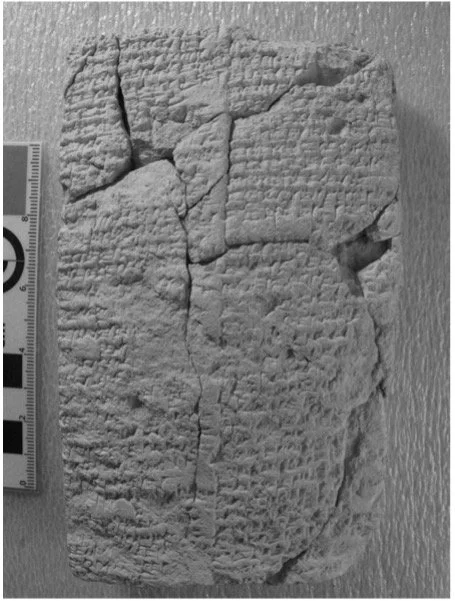
A 7478 obv., rev., and edges. Oriental Institute, Chicago
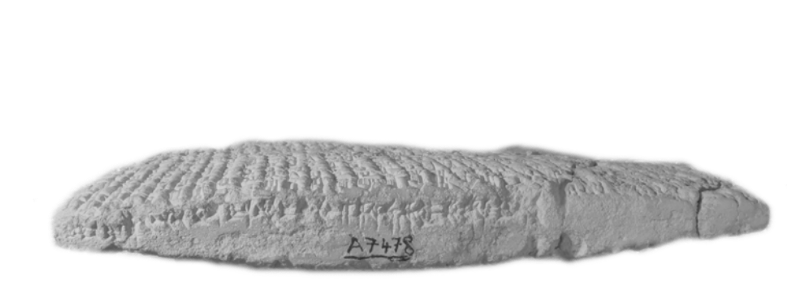
A 7478 left Edge
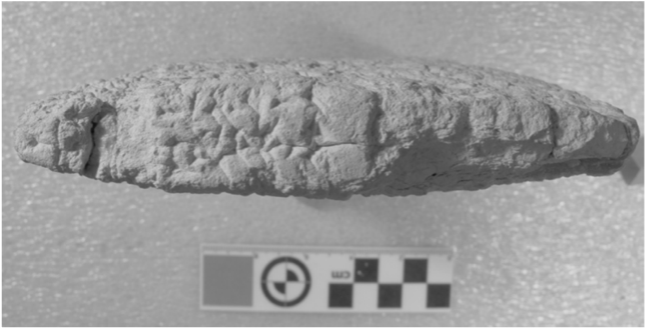
A 7478 Lower Edge
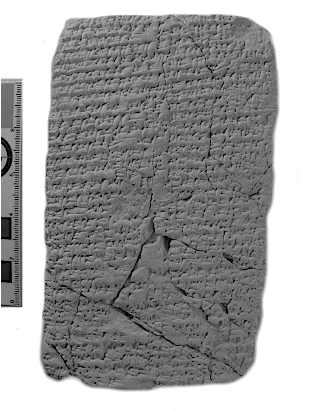
A 7478 Obv.
A 7478 Rev.
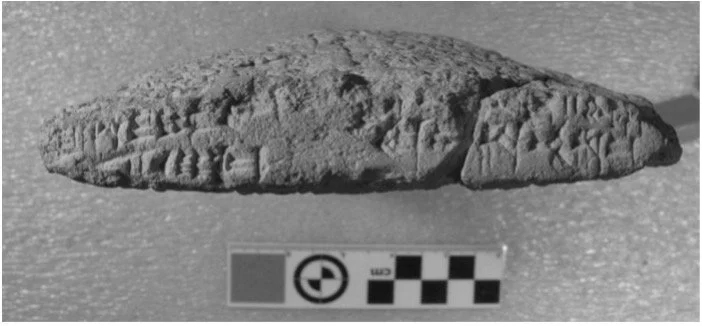
A 7478 Upper Edge
SEAL no. 1622 (https://seal.huji.ac.il/node/1622) on Michael P. Streck and Nathan Wasserman, Sources of Early Akkadian Literature: http://seal.huji.ac.il.
Translator’s Note
A 7478 is an Akkadian love poem from Sippar or Nippur (1900–1600 BCE). In Akkadian, logograms represent syllables, so though there are over fifteen hundred signs of A 7478, there are less than a thousand referents. These syllables form roots, prefixes, and suffixes, and rest their legibility on Sumerian, the only language that prevenes Akkadian. Poems like A 7478 are regularly found and highly favored; version after version of these love poems are recovered from one archaeological ruin to the next. This reveals an oral history that overruns in the tablets, and a readership that insists for more.
The lines of this poem fill the obverse, reverse, and verges of A 7478. They are utterances from a first-person feminine narrator to her partner, a third- and second-person masculine recipient. Italicized in this rendering is also third voice, the narrative’s voice, interrupting the lovers and their verses. The narrator is in love. She reveals this through regular references to her hunger for the recipient, to the “flesh-pleasures” he offers her, or the tender names they calls the other (“my pet,” “master”); she likens their relationship to various forms of nature, fruit, ritual offerings. The two are removed from one another, though—the narrative tells us that their lives no longer relate, their trails no longer cross. Rather than in link, “he follows … her,” and then, “they follow one another.” “The years have set and fallen” like this, she recites, “the moment of return / refuses us as a mother.”
The narrator nonetheless reaches for her lover, looking for the flirtation she recalls in their relationship. “Flirtations” is, I think, the most fitting name for this poem. The feminine narrator knows the feel of her lover’s flirtations, longs for it. “you fasten a natality for me in strings,” she tells him. And she herself flirts—with the memory of him, with her narration, her form. He is a “flash” in her history, yet the request on her lips never changes: “[let me] have parts of you as a rite.” “Flirtations” recognizes the poem’s courting. It also recognizes its moments of vulgarity, and of heightened need (those “flesh pleasures,” the “hunger”).
The narrator’s rhetoric is, orthographically, not regular. There are lines of kink here—she lyricizes herself in “oil,” or, in “ropes”—and there are lines that feel tenderer—she lingers, halfway through, to look at her lover “sip” and rest near the Tigris, less a voyeur than a thrall. She is his “feminine veneration,” and he her fetish; she is a “net holder” and he her catch. Rhetoric of the erotic lies next to rhetoric of the natural, for her.
My rendering tries to honor how the narrator teases language. It is poetic, and leans from more familiar referents. An example is the final line. “I, through / your reverence, / through your flirtation, and your favor, find my refuge.” Others have left this as “through your love-making,” or something even racier. In “flirtations,” though, I have kept the flow, the faithfulness, the longing, in the voice of the narrator that, though elsewhere vulgar, in these verses expresses only the feeling of release (via her lover and from him).
In a final note, this archive is fragmented in a material sense—there are rifts in face of A 7478, some small and some not. Artifacts from the ancient Near East often have this look, this feel. Rows of ellipses in the narrative reflect this, and they are kept in my rendering. “i received… / steady heaving,” the narrative inhales, exhales, “…in each vessel-site, / … as heaven is heavy.” These verses have the feel of language expressed in love, like the narrator is lunging for respiration. The result of this is a poem that rifts and heaves, in and past the narration.
-
The author of the original text is unknown.
-
Samantha Reilly is a PhD candidate in religion, fetishes, and the ancient Near East.