Afterthoughts 02:
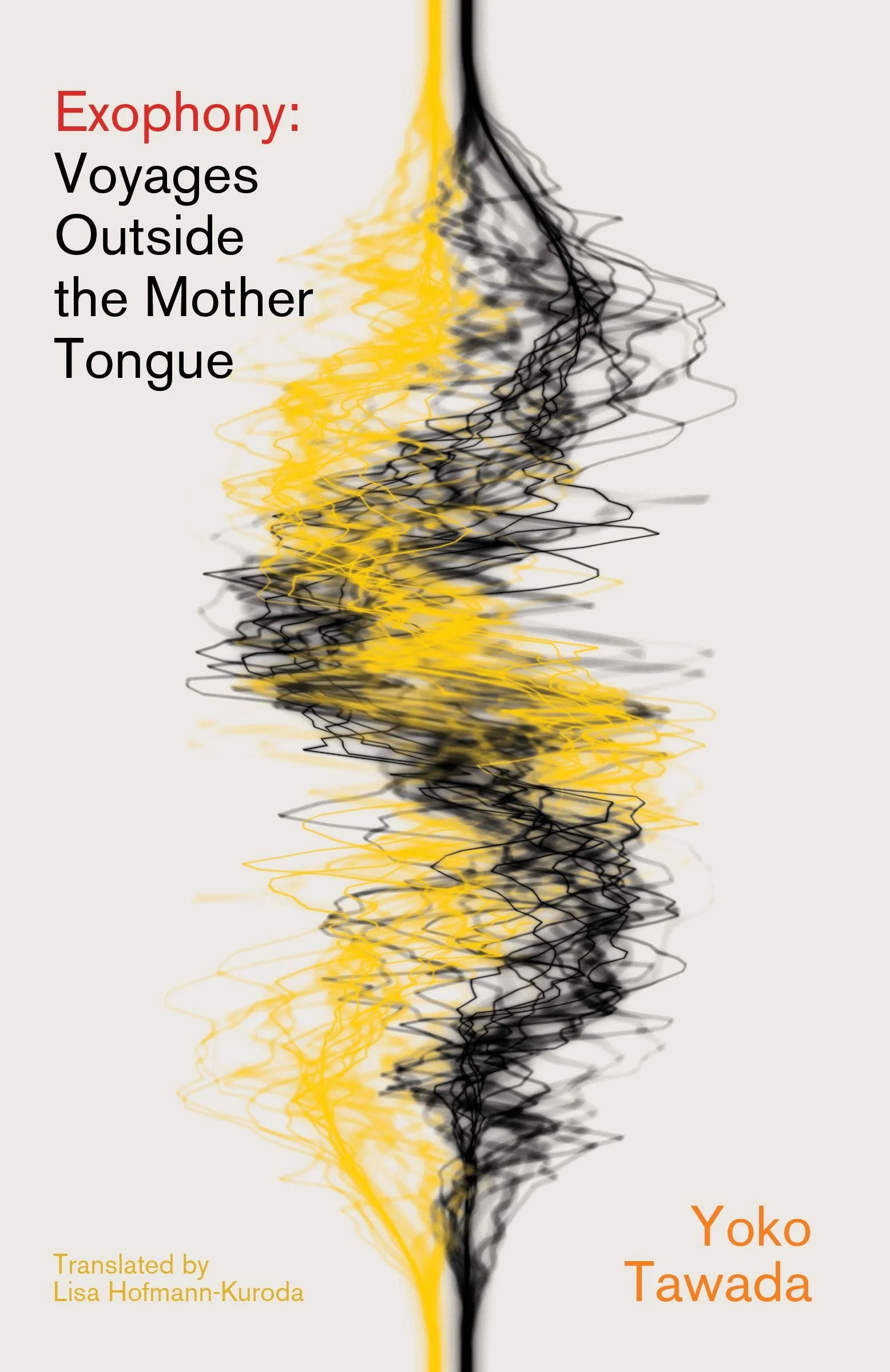
Exophony: Voyages Outside the Mother Tongue by Yoko Tawada, tr. Lisa Hofmann-Kuroda
This review is part of Afterthoughts, a series written collaboratively by members of the Translation Theory and Practice working group at the Obermann Center for Advanced Studies, University of Iowa. Our contributors draw on Comparative Literature, Literary Translation, Philosophy, English, Creative Nonfiction, Classical Chinese, French, Italian, and Religious Studies. Rather than issuing a single verdict, we record the conversation—partial, sometimes conflicting—that a work sparks across our disciplines.
Reviewers: Reviewers: Nataša Ďurovičová, Cherrie Kwok, Tommy Mira y Lopez, Morten Schlütter, David Stern, and Jan Steyn.
Exophony: Voyages Outside the Mother Tongue is a book whose focus is dispersed across genres, languages, audiences, and moments in time. Its author, the Tokyo-born Berlin-based Yoko Tawada, is best known as a major contemporary writer of fiction and essays whose work is shaped by an unusually rigorous and creative multilingual practice: rather than merely thematizing linguistic displacement, she has long written in both Japanese and German, addressing distinct literary publics and publishing contexts across two languages that occupy powerful positions in world literature. This book, new to English, but available in Japanese since 2003, consists of a series of brief, self-contained chapters, many named for a world city or place, often linked to an occasion (a lecture, a reading, a residency) that Tawada attended or remembered, and each unfolding its own anecdote or linguistic reflection. Its itinerant structure – its drift from Dakar to Seoul, Cape Town to Los Angeles, Oku Aizu to Moscow and further, complemented by a second part titled “Adventures in German” – means that the book can often seem disjointed and a bit repetitive: a strange collection of occasional pieces whose local logics accumulate rather than synthesize.
What emerged in our discussions was a shared sense that Exophony gains meaning through context. It is a book that becomes richer when read alongside Tawada’s broader body of work, and when situated within the early-2000s moment of world literature in which these essays were written. Reading it now also means seeing Exophony as a text that uncannily anticipates contemporary concerns in translation studies, multilingual writing, and world literature – concerns that have been taken up not only in criticism but in Tawada’s recent fiction. Several of us found that familiarity with Tawada’s novels deepens the experience. Exophony is not fiction, but it reads retrospectively like an announcement or seedbed for themes that would later become central to her stories: linguistic estrangement, animism, self-othering, playful misalignment between bodies, languages, and categories.
Three of us, in particular, had been reading Tawada’s recent speculative trilogy alongside Exophony, beginning with Scattered All Over the Earth. The trilogy appears in English translations by Margaret Mitsutani, a long-established and widely lauded translator whose work has done much to shape how anglophone readers encounter Tawada’s fiction. In the first novel, Tawada imagines a near-future world in which Japan has vanished and its former citizens wander through a linguistically fractured landscape, inventing new speech forms and improvising new communities. The book’s multiple narrators and episodic drift create a world where language is unmoored from nation, where belonging is provisional, and where translation becomes less a professional activity than a condition of survival. Its continuation in Suggested in the Stars (and Archipelago of the Sun) extends these questions in stranger, more expansive directions, exploring disappearance, diaspora, and the fragile infrastructures of communication.
What is striking, too, is that these novels have arrived in English at roughly the same moment as Exophony. In the anglophone world, Tawada’s early essays and her recent speculative fiction have thus become contemporaneous, even though the essays were written decades earlier, and specifically for a Japanese audience. Part of this synchronicity reflects the care with which two different translators have helped bring Tawada’s work into English, both under the aegis of New Directions. Exophony is translated by Lisa Hofmann-Kuroda, whose Translator’s Note is itself an education: an afterword that patiently reconstructs the linguistic ground on which Tawada is writing, from the interplay of Hiragana, Katakana, and Kanji to the book’s invented portmanteau words. Hofmann-Kuroda makes newly visible what Tawada could assume for her Japanese readers, and she does so with an attentiveness to both the comedy and the ethical weight of exophony, including Tawada’s insistence, in “Seoul,” that “people have no right to proselytize about the joys of exophony if they have never been forced to speak in a language not their own” (52). Translating these essays into English is therefore not simply a matter of carrying Japanese into another tongue, but of mediating a multilingual text saturated with German intertext and its unique place vis a vis Japan, Chinese characters, and the politics of linguistic aspiration. Its particular political-cultural amalgam, of (modern) Japan and Germany, also posits the essays at a somewhat oblique angle against currents in contemporary translation theories/politics, often dominated by concerns linked to anglophony: on her account here, “power” isn’t to be ignored, but is more aleatory, less given to crushing.
Part of what makes Exophony resistant to summary is its range. The essays are quirky, time-stamped, and place-specific, capturing a particular snapshot of early-2000s literary culture, including writers and institutions connected to transnational circuits. This looseness is part of the book’s appeal. Tawada advances her ideas through humor, anecdote, and estrangement rather than in a manifesto spirit, offering example after example without it being rammed down our throats.
As a group with varied linguistic expertise, we were especially attentive to the book’s multilingual dimensions: the German passages, the Japanese contexts, the shadow of Chinese characters, and the fact that these essays were written for a Japanese readership. This makes the English translation, and the translator’s framing of it, particularly significant. It is all the more interesting to encounter Tawada’s reflections on German and Japanese in English, tracing the artful way Lisa Hofmann-Kuroda translates Tawada’s examples, some originally in Japanese and some originally in German, without – seemingly – dropping a ball (even while feeling it bounce).
At the same time, this translational relay can occasionally feel uneasy. More than one reader in our group had the impression that Exophony in its English version can’t overcome the fact that it is directed toward a Japanese audience, and that some of the translations of Tawada’s German to English and the ensuing discussion can at times seem somewhat off. This is less a flaw than part of the book’s defining “shadowiness”: languages hover behind one another, never fully settling.
One especially revealing instance comes in Tawada’s final section on “sensed meaning,” where she turns to the ambiguity of Sinn and kanno and their translation. Here we found ourselves lingering over the way a single word can carry multiple lives across languages. Sinn – “sense” – is one of those central terms in the philosophy of language, and Tawada begins from the different meanings of sinnlich (sensual) and sinnvoll. She finds it surprising that “sensual” and “senseful” share a common root, namely Sinn, usually translated as “sense” or “meaning.” And yet some of us felt that Tawada takes the notion of purpose or usefulness to be central to the second sense of Sinn. Her examples of what is sinnvoll are often examples of what is practical or rational, such as booking a seat on the train, or buying travel insurance. But what we say and do can have a sense, a meaning, even if it’s not useful, or serves no purpose. The disagreement comes out particularly clearly when she writes that “The opposite of sinnvoll is sinnlos, which means ‘useless’” (158). That’s just wrong: it means ‘senseless.’
Here it becomes difficult to know, of course, how much to attribute to Tawada’s own interpretive play, and how much to her translator’s specific choices, and the layered relay of translation in general. But the moment is instructive. In the midst of Tawada’s observations on sensuality and sensibleness, she can seem to lose sight of one of the key meanings of Sinn: meaning itself, what our words mean. She shoots off several incompatible philosophies of meaningfulness in the space of a few paragraphs, moving from a radical empiricist view to a more modest one, then toward a naturalistic account of meaning as filtered through a web of many things, including the person’s ideas, experiences and moods. Ours is consequently not simply a pedantic quarrel. It exposes something central to Exophony: the way linguistic estrangement can generate insight, but also, in its advocacy for in-betweenness, semantic wobble. Exophonic writing is not a stable position outside the mother tongue; it is a practice of living in the relay—and sometimes relay in relay.
Living in the relay also raises the on-going question of what a translator’s responsibility might be amidst the messy webs of interpretation, meaning, and mood—a question that becomes especially pertinent when Tawada considers how Japan’s colonization of Korea had “forced the Korean people into an exophonic condition” (53). Even as she insists on the impossibility of cultural or linguistic purity, she experiences discomfort when discussing the Korean language and its enforced entanglements with Japanese on one hand, and Chinese on the other. “I could be more irresponsible,” she explains, “when writing about Senegal. But with Korea, I feel responsible – to the point where whatever I write about it feels like self-deception” (56). Her frank admission is an important reminder that not all exophonic conditions were freely chosen. Forces such as colonization have done much to coerce a population into speaking a language that they would not have chosen for themselves. This is a reality that is relevant not only for those colonized by the Japanese Empire, but also by the British Empire, whose imperial might is evinced by the global dominance of English and Anglophone literatures today. What, then, is the translator’s responsibility within and against the histories that we have inherited?
We also found ourselves returning to the way contemporary discourse on exophony often takes a defensive stance, something like: exophony, far from being a deficiency, is a fact of life in the contemporary world, so learn to deal with it. Tawada’s approach is different: marked by an agonistic stance to linguistic power relations and a benign view of interlingual relations as always in dynamic shift. Even English becomes for her simply one strand in the weave of ubiquitous exophony.
One of the book’s most suggestive implications is that monolinguals too are inhabited by exophony. Etymologies, borrowed figures of speech, puns, and moments of estrangement release the spring of creative writing itself. (It is perhaps no accident that we found ourselves thinking about how difficult it would be to translate this book’s in-betweenness by purely automated means.)
Why this book now? More than any other question, this was the one we found ourselves returning to. Tawada was writing these essays at a moment when exophony still named something emergent, but the term has since become central to conversations about translation, multilingual writing, migration, and the ethics of linguistic belonging. Read today, the book’s multilingual shadowiness feels newly legible, even newly urgent. Part of the answer lies in the frame Lisa Hofmann-Kuroda provides in her Translator’s Note, which insists that exophony is not merely a stylistic experiment but a way of seeing what monoglot comfort can conceal, and that linguistic dislocation can be both a site of play and a site of violence, depending on the histories that compel it. Tawada’s later speculative novels may develop these questions more fully in fictional form, but Exophony remains a generative point of departure: a writer thinking across languages and borders, reminding us that literature often begins where languages do not quite align.
-
To learn more about the Obermann Center for Advanced Studies and its working groups at University of Iowa, click here.