
INTRODUCTION | ISSUE 5
This issue had a unique fluidity from start to finish, perhaps because it allowed us a protected collegial space to think about and nurture translation work. The content of the pieces—indeed, this magazine’s contents, to nod to Genta Nishku’s translation of Migjeni—resides in interior landscapes: apartments, pharmacies, editorial offices, village shops, dark corridors, packed train cars, small squares… Two authors deal directly with customs offices (Yosel Cutler and Galina Istkovich), both an inside space and a no-place between nations. Even Birhan Keskin’s poems, the most exterior of the group, have a quality of boundedness, rendering wild and vast “earthly conditions”—a flamingo, the sea—in their most compressed and intimate forms. Still, amidst all this closed materiality, there is a sense of opening—to family, loss, and lives past and future.
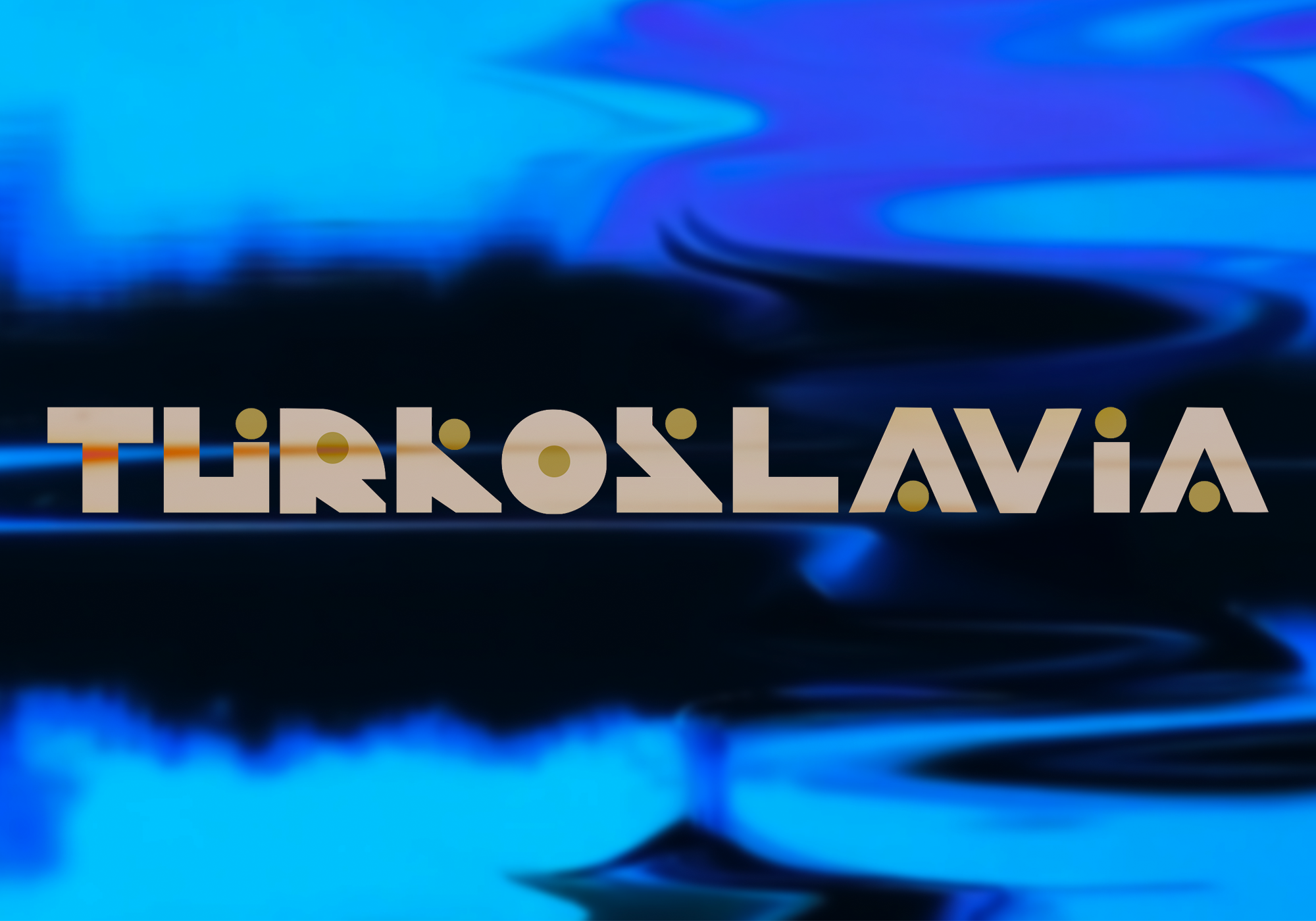
This issue’s hazy, intramural content is met by Faina Yunusova’s artwork, which has the disorienting quality of a landscape pressed into a Rorschach test. Our guest graphic artist for the issue notes that her featured artwork, called PATTERTONIC, mirrors her own current interior landscape—and here it is: blue, blue, blue. (Yunusova’s work was guided by an older piece she did in oil.) When discussing how to pair the images with the works of literature, we interpreted them altogether differently, seeing, by turns, a strand of hair, a mountain, a phallus, a missile, a ripple in water—and even differing about whether the images were vertical or horizontal. Amidst such uncertainty, the images dock alongside the issue’s interiors, both settled swayingly at the threshold of perception.
So what do we have? Four prose and eight poetry pieces, with new languages added to our inter-imperial family: Albanian, Ukrainian, Yiddish, and Latvian. As always, we’re happy to welcome back previous contributors—in this case, John Hennessy, Jacob Mikanowski (offering more translations of Eugeniusz Tkaczyszyn-Dycki’s poetry), and Öykü Tekten. Two of the poetry contributions are excerpted from newly published or forthcoming translations: Earthly Conditions by Birhan Keskin, translated by Tekten, is out with World Poetry Books, which will publish Ainsley Morse’s translation of Vlado Martek’s Pre-Poetry later this year.
We hope you enjoy Issue 5, and we remain grateful to everyone who made it possible:
Elina Alter, Yosel Cutler, Neil P. Doherty, Moisei Fishbein, Venya Gushchin, John Hennessy, Galina Itskovich, Vilis Kasims, Yücel Kayıran, Birhan Keskin, Ostap Kin, Mustafa Köz, Maria Malinovskaya, Vlado Martek, Mordecai Martin, Derick Mattern, Will Mawhood, Migjeni, Jacob Mikanowski, Ainsley Morse, Genta Nishku, Kevin M. F. Platt, Lara Radović, Ian Ross Singleton, Alexander Skidan, Alina Stefanescu, Eugeniusz Tkaczyszyn-Dycki, Öykü Tekten, Sandra Vlašić, Faina Yunusova, and Sergei Zavyalov.
A NOTE FROM THE GUEST POETRY EDITOR ALINA STEFANESCU
Meeting to discuss these extraordinary translations with Ena and Sabrina was a gift and a marvel. With each poem, language, affect, temporality, and narrative constellated as lustrous possibilities, a reminder that no single translation is authoritative enough to be final. Nor can any ethnicity or nationalism be a definitive account of the humans gathered in its name. Every translation embodies the traces of its author, and this intertextuality—this sense of being between and of multiple languages and cultures—reminded me of Svetlana Boym’s essay on Vladimir Nabokov. Nostalgia may be driving but “non-return” is the primary literary device in Nabokov’s work. This sense of possibility in a not-yet-nationed nostalgia links up with what critical theorist Theodor Adorno described in his memories of Amorbach, that childhood land of vacation that preceded identifying with a national flag. In the village of Amorbach, Adorno identified with the language. Simultaneously local in its particulars and global in its cosmology, Adorno’s sense of self (or being) developed alongside that of the local flora and fauna. The sheer expanse of geographic and linguistic terrain traversed in this issue of Turkoslavia is breathtaking. I remain awed by the sensitivity and skill of its translators, awed, too, by the privilege of thinking with the poems themselves. Thinking, after all, is what writers do. When thinking through Nabokov’s nostalgia, Boym described it as “metaphysical longing for the lost cosmology of the world” that is given to us in “the patterns and gaps” between words and places, “in ellipses that should never be spelled out.” Perhaps these ellipses punctuate the work of translation itself. This is the beauty and terror of language. We owe translators so many worlds. Perhaps Vladimir Sirin, the poet persona, got killed off by the creation of Vladimir Nabokov, the novelist persona. But nothing is killed off in the translations you will read. Nothing is finished. Everything flows, flourishes, shifts, and continues.
ABOUT THE GUEST POETRY EDITOR
Alina Stefanescu was born in Romania and lives in Birmingham, Alabama with her partner and several intense mammals. Recent books include a creative nonfiction chapbook, Ribald (Bull City Press Inch Series, November 2020) and Dor, which won the Wandering Aengus Press Prize (September 2021). Her debut fiction collection, Every Mask I Tried On, won the Brighthorse Books Prize (April 2018). Alina's poems, essays, and fiction can be found in Prairie Schooner, North American Review, World Literature Today, Pleiades, Poetry, BOMB, Crab Creek Review, and others. She serves as editor, reviewer, and critic for various journals and is currently working on a novel-like creature. My Heresies, a poetry collection, was published by Sarabande in late April 2025. More online at www.alinastefanescuwriter.com.
ABOUT THE GRAPHIC ARTIST
Faina Yunusova, an interdisciplinary artist working between Uzbekistan and Germany, navigates the complexities of her cultural background, seeking to create artistic representations that resonate with depth and authenticity while embracing the fluidity of contemporary existence. In her artistic practice, Yunusova focuses on self-reflection and societal inquiry, exploring themes of memory and communal expectations in the digital age. Her portfolio spans monumental painting, photography, video, digital art, artificial intelligence, performance, and installations.